Sunday, 16 October 2022

How do Political Philosophers approach the topic of Taxation?

When reading a new book Political Philosophy and Taxation, I became curious about how my fellow political philosophers would approach the topic. 

To test my assumptions about this I set up a poll - thanks to those who responded! 

I will set out the results below. 

Method 

I created an anonymous poll with two questions: 

  1. What is your own preferred approach to the issue of taxation? [Multiple choice with an optional write-in option]
  2. What do you think would be the dominant approach to taxation among political philosophers generally? [checkbox of the same options as the above, with a write-in option]

I thought asking these two questions was a good idea as each of these questions on their own might not have been informative and comparing the two might prove useful (it did).  

On reflection, perhaps I should have asked a third question to check what sort of level the respondent was working at, since the survey was open to anyone. 

I spread awareness of the poll in two ways:

  • via a tweet. I didn't have that many followers (around 450), but I requested (begged) retweets from fellow political philosophers and some specialist publishers, academic centres and professional associations. I focused on accounts with a reasonable amount of followers (but not too many) who were likely to also be political philosophers.
    The tweet was retweeted by 20 account and received 6,000 'impressions.' Apparently over 100 clicked on the link via twitter which is a lot fewer than took the survey.   
  • via the PHILOS-L email list. This is an email list for philosophers with 13,000 members. Many of these will be moral and political philosophers.
    The number of people taking the survey had a big rise after I posted on PHILOS-L and an even bigger rise (the most substantial) in the 24 hours after it was included in the digest.  
So while I did not limit or check submissions, I am reasonably confident that the responses were a fair representation of the profession. 

Results

I received 79 responses in 5 days, though one was blank so it says 78 below. 

Response to Q1
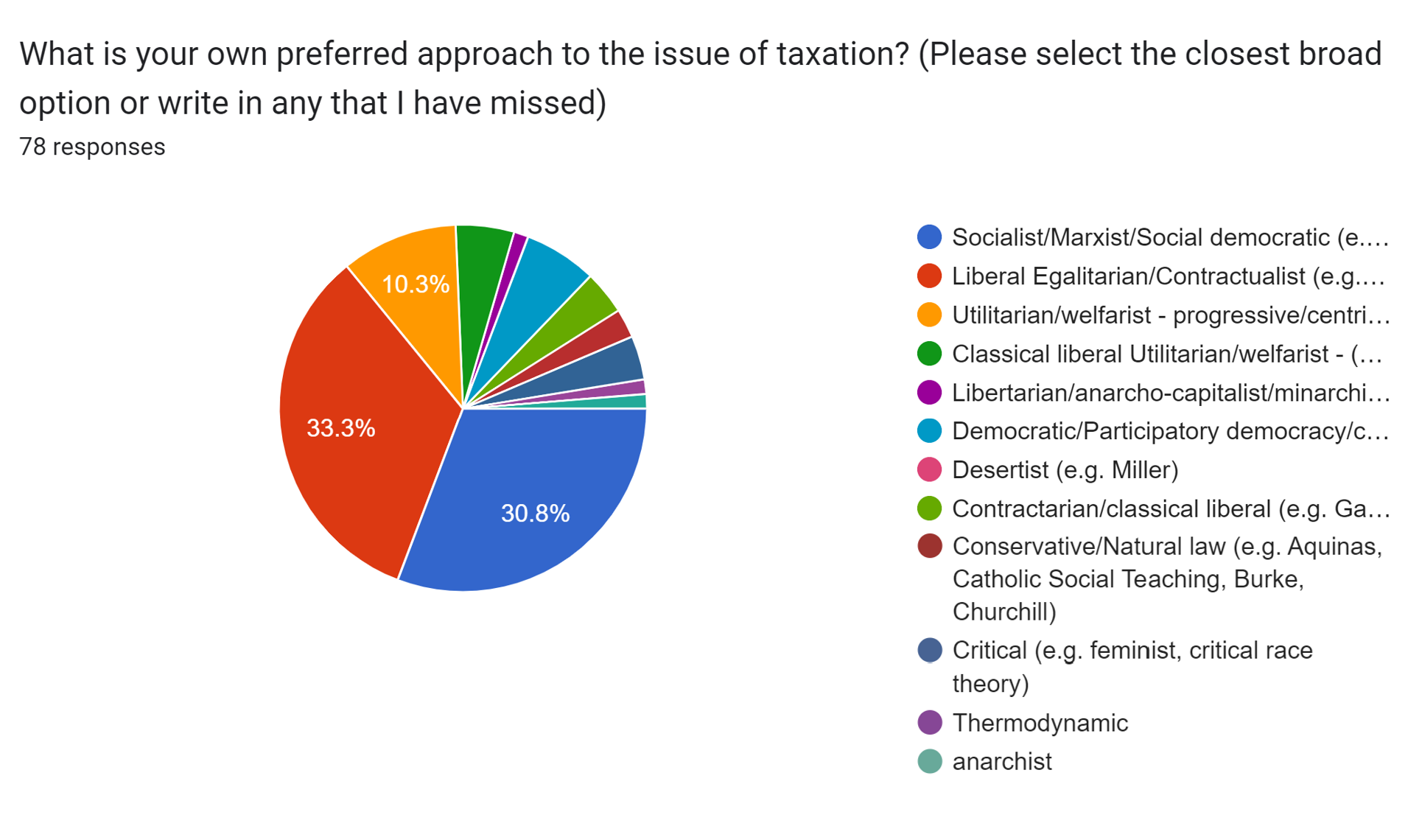
A third of the responses were for "Liberal Egalitarian/Contractualist (e.g. Rawls, Dworkin, Barry, Scanlon)"

Just behind was 30% who went for "Socialist/Marxist/Social democratic (e.g. Marx, Bernstein)"

15% went for Welfare-maximizing options, though they split with only 1/3 of those being on the economic right. 

10% gave economically right-leaning responses (classical liberal or libertarian) with a further 2% going for Conservative. 

5% went for the broad participatory communitarian or democratic common good option that I offered.

5% went for other radical options, including a write-in answer of 'anarchist' (which I assume must be left-wing anarchist given the anarcho-capitalist option offered)

Response to Q2

The response to the second question proved to be a useful check on the first, and also telling about what political philosophers think of their fellows. 

Forms response chart. Question title: What do you think would be the dominant approach to taxation among political philosophers generally? (you can't select more than one if you think there are a few that are equally dominant). Number of responses: 78 responses.

69% of the responses were for "Liberal Egalitarian/Contractualist (e.g. Rawls, Dworkin, Barry, Scanlon)." This is the approach that I take, and I assumed it would be the most common one. It is clearly considered the 'mainstream' approach by members of the profession.  

I didn't find any obvious patterns in comparing the way that individuals responded to q1 & q2 directly. 

Overall conclusions

As mentioned I undertook this for my own curiosity, but several people contacted me to express interest in the results and I can see why! 

The question is essentially 'how do political philosophers approach the topic of distributive justice.' 

It is very interesting for us to check the theoretical/political leanings of the profession and find out what others in the profession think about the leanings of the profession as well. 

The responses were roughly what I expected, with socialist/social democratic being more popular than I expected. There are of course many overlaps between the options. For instance, liberal egalitarianism can overlap somewhat with social democracy (particularly with regard to Rawls and Piketty). 

The responses prove my thesis that free market desert theories (0%) and libertarianism (1%) are very much outside the mainstream (I would say correctly so!). 

I would be happy to get your thoughts on these results in the comments below! 

Monday, 4 July 2022

My Adult education courses for 2022-3

My courses for the next academic year are now available to book. 

Click here for the latest version of the list of courses I am teaching. 

However, I thought I would list them here. I will list them by format. 

Online Courses 

Political Philosophy: An Introduction (flexible online)
Flexible course with 24/7 discussion forums. Runs every term.
I am almost always the tutor on this course. 

Public Policy Economics (Online)
Flexible course with 24/7 discussion forums. Runs every term.
Mostly taught by other tutors, but sometimes I am the tutor.

Justice for Future Generations: Environment, Population and Climate
Thursdays 4-5pm.
22 Sep - 1 Dec 2022

Political Economy of Taxation
Mondays 3:30-4:30pm.
16 Jan - Mon 27 Mar 2023

International Ethics and Global Justice
Mondays 4-5pm
17 Apr 2023 - Mon 10 Jul 2023

In recent years I have also taught online courses over the Summer as well - look out for these in the new year.

Weekly Classes (10 weeks) in Oxford

The Ethics of Capitalism
Wednesdays 7:30-9:30pm
28 Sep - 30 Nov 2022

The Ethics of Life and Death: From Assisted Dying to Just Wars
Wednesdays 4:30-6:30pm.
25 Jan - 29 Mar 2023

Does Justice Apply Beyond the Border? Trade, Aid and Migration
Thursdays 7:00-9:00pm
27 Apr - 29 Jun 2023

Day Schools 

The Limits of Free Speech: Offence, Hate Speech and No Platforming
Saturday 25 Feb 2023

In Oxford and online (hybrid event)

Summer Schools (Oxford)

Ethics of Capitalism - Sat 15 July - Sat 22 July 2023 

Should borders be open? The Ethics of Immigration - Sat 29 July - Sat 05 August 2023

I hope you will be able to join me on one or more of the above, and that you will tell anyone you know who might be interested! 

Saturday, 14 May 2022

Book Review: Elizabeth Cripps - What climate justice means and why we should care


Book cover - Cripps what climate justice means and why we should care
This week I got hold of a few books I've had my eye on for a while. 

Although I've got an infeasibly huge pile of research and teaching reading to do I thought I would take a little look at one of them - What Climate Justice Means And Why We Should Care by Elizabeth Cripps. 

I ended up reading the whole thing over two consecutive afternoons. 

This really demonstrates one of the great things about this book - the writing. Cripps is a former journalist and it is written in an extremely clear and engaging way. She introduces real-life cases and examples wherever possible to illustrate the impacts of climate change. 

The book is extremely accessible for a book on morality and justice.

The Moral imperative
This accessibility  is important because it is the impact that climate change will have - is currently having - on vulnerable individuals and groups around the world that makes it such a pressing moral issue. The climate tragedies will occur on a small - human - scale. People's lives will be ruined by droughts, floods, storms and so on that would not have occurred were it not for climate change. These tragedies are completely out of sight when we drive our cars or heat our homes or buy our products. 

Indeed, the issue of scale is one of the big problems with climate justice. Climate change is caused by cumulative emissions consisting of (usually) small amounts of emissions from billions of people - it is a macro problem. However, the impacts will be felt by vulnerable individuals in the future. Cripps reminds us to think about those individual stories.

Our own attempts to do something about it can seem tiny and insignificant, but we all have a moral duty to make those attempts. Cripps sets out the arguments here with admirable clarity. She also does the great service of listing and responding to some of the common counter-arguments. These really do not give us any moral excuses. 

Our own duties
What are our duties as individuals when it comes to climate change? Cripps' previous book was on the topic and so she covers this very well in the final chapter. 

Part of it is considering our own lifestyles and whether we can take reasonable steps to reduce our greenhouse contributions (think cows, planes, cars and draughty houses). 

However, since the issue is really a global one that no individual can resolve we also have the duty to act politically as well. This means supporting parties that take climate change seriously and will act on it. However, it is a flexible duty - it depends on our own position in society and our own skills. We can't all be Greta Thunberg but we can all make our small difference. This could be by changing our pension investments, challenge climate falsehoods when we hear them expressed, installing solar panels and heat pumps when we get an opportunity. 

Cripps sets out six highlights from the book at the end, and seeks to inspire us all to take the steps needed. 

Too emotional?
The book was very accurate when it comes to the issues and arguments. I had a slight concern that it tipped into the bombastic with a couple of comments that climate inaction or denialists 'might just kill us all.' 

Critics (wrongly) accuse climate activists of being irrational and overly-emotional. (The likes of Greta Thunberg can't win can they - too nerdy/robotic/scientific when presenting the science/facts and too emotional when demanding necessary actions). So there is a concern that this kind of language plays into the hand of the critic. 

On the other hand, Cripps does use the word 'might'! 

While it seems unlikely that climate change will end humanity, there might be some extreme scenarios where it triggers something like a nuclear war or mass extinction or something that ends civilization. Perhaps a few humans might survive even that but it would in fact pretty much be the death of all of us. 

I don't think that this will happen and Cripps' argument generally rests on the point that vulnerable people will die because wealthy people refused to take reasonable steps to limit their emissions (and in some unforgivable cases even spread misinformation designed to block such action). 

Summary
I didn't read every word of the book - I've taught this topic several times myself and so I'm familiar with a lot of the arguments. I felt I could skim over the summaries of those arguments. I didn't take the book to be aiming to give novel arguments for philosophers. Rather, it is aiming to explain to those unfamiliar with those arguments why we have a moral duty to act. Why a failure to act is unjust and therefore wrong. This is the latest test for humanity and we aren't quite covering ourselves in glory. 

In general, I like to think that this book would be suitable for someone who does not pay too much attention to the issue of climate change and thinks that there is no need for them to consider it. They are the people who need to get the message and Cripps has put her considerable research and writing skills to their best possible purpose by presenting that message in clear form.