Showing posts with label solar. Show all posts

Monday, 11 March 2024

First year of solar generation

 We had out solar and battery system installed a year ago and so I thought I would share the stats! 


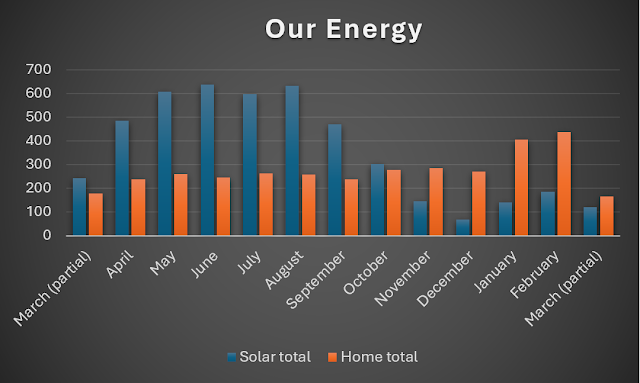
Yes, we generated 4.64 MWh and we used 3.2 MWh, meaning a surplus of 1.4MWh! 

We got a BEV recently, though, which will use up a lot of that difference in the future. But we have about 4k miles worth of spare capacity there. 

Here is the usage and generation broke down month-by-month. Big surpluses from April to September, March and October are break-even months, and November – February we are in deficit. 

Not too surprising given that we have an East-West roof rather than South-facing. 

We had some data connection issues in November and December so for those months the data might be a bit lower than it should have been, but not by a huge amount. 


Graph of solar generation and home electricity usage


What are the conclusions? 

I'd say "get as many solar panels on your East/South/West facing rooves as they can fit."

We need to switch over to renewable electric energy ASAP, and to "electrify everything" in order to "stop burning stuff." 

I kind of wish we could have crammed a few more panels on there, given that the panels themselves are pretty cheap and a lot of the cost is the electrical work. However, we had a budget at the time. 

Sunday, 15 October 2023

Givenergy Inverter Error: Electricity Meter Com Fail

 I had a problem with my Givenergy Inverter and I thought I would share my solution as I could not see anything about it online. 

It wasn't a huge problem, but it was a little annoying when you are an energy geek like me. 

Essentially, the inverter stopped providing data to the cloud and therefore I could not see what was happening on my givenergy webpage or the phone app. 

It was disconcerting as I could not see what was happening and whether the battery and solar were working or not, let alone how they were performing. For all I knew they had shut down and it might have been dangerous. 

Photo of Consumer unit with fuses, including one with a green display and button.

What caused the error?

I think the error occurred when I turned off the lighting circuit next to this one in order to change some lightbulbs (see photo). 

I later realised that I wasn't getting any readings from the inverter.

What form did the error take?

There was no data being received about the energy going in and out of the meter. 

Looking into the reports on the web portal, there was a new error "Electricity Meter Com Fail." 

The inverter lights were on, which was reassuring, but the circle of light in the middle was yellowish, which I later learned indicates a communication problem. 

I could not see any advice about how to fix this issue online and so I tried a few things.

Eventually I went to bed defeated as it was nearly 1am and I wasn't getting anywhere.  

In the morning I continued to look up the problem and what it might be.  

I was getting battery data but not solar and grid data. I found the smart meter device to check if it was exporting. (I never use this device because the inverter provides much more useful data via givenergy). 

Simple solution

I believe I solved the problem by doing the following:

  • Pressing the set button on the electronic meter in the consumer unit. I did this last night and it did not achieve anything. 
  • However, today I also held down the button for a few seconds. This seemed to get the device to go through some sort of process and afterwards the readings resumed. 

So there you go - as simple as pressing the button on there to get it to reset itself. 

Phew! 

So the system was seemingly working throughout. I only missed about 18 hours of data collection on the solar generation and grid import/export but the electricity company will have been measuring my import and export so the data is just for my own records. 

However, it was quite a worry that there was a problem with the system over the weekend and that I might have to contact givenergy or my installer to get advice, possibly facing a callout charge or something. 

All in all, it has worked out fine, but I wanted to save others the stress by suggesting what might be a simple solution to a frustrating and disconcerting issue.  

Wednesday, 19 April 2023

Advice for getting solar systems in the UK

 A few people have asked me for advice about getting solar panels since I posted about our newly installed system. 

There is lots of general advice out there, and installers will of course look at your particular situation. 

For instance, Artisan Electrics has a video with good advice on the topic, which mentions a lot of the practical considerations. 

There are lots of things to think about, like what roof you have and whether it is in the shade at all. Having some shade isn't a dealbreaker (you can always get a micro-inverter for each panel), but you could have a look at your roof at different times of the day to see whether any nearby trees or rooves cast shade.  

Essentially, you want to get an MCS approved installer. They have to abide by high standards and only MCS installed systems can generate export payments. You certainly want to get paid for your excess if you are having a large system installed.  

I found the sales people generally quite useful for reviewing the options and coming up with a proposal they believe is in your financial interest, based on their own assumptions. 

However, there are a few things that installers might not flag up to you.  

Future proofing? 

As I mentioned in my previous blog, the focus tends to be on covering self-consumption. This is because you can be sure that you will save money on your electric bill if the solar (or solar and battery) covers that. 

After all, the export payment rate has been very low in recent years, so there has been little incentive to use your roof to supply the grid. 

However, there is no way to truly work out the payback time for a solar system - it depends on too many unknown future factors. How much will your electricity bills be in the future? What will your demand be? What will the export price be? Nobody knows for sure - certainly not me!  

Higher rates in the future?

However, that might not always be the case. New tariffs like Octopus' Flux tariff are offering rates several times that of the longstanding (but paltry) Standard Export Guarantee. However, these higher rates aren't guaranteed and the entire tariff might be withdrawn at any point. 

Nevertheless, if you look at all the plans to build solar farms and the controversy raised about them, it seems like using rooves is much less controversial. If all rooves were covered in solar and every house had a battery it would really help the country continue to run on clean energy through windless days after all. 

I certainly can't guarantee what export rates will be in the future, but I expect that if you've got a battery you will be able to use this for energy arbitrage - buy when the price is low and sell when it is high. 

Higher electricity consumption in the future?

But the other reason to think beyond your current use is that your use might increase in the future. 

Obviously, we are all looking to get more energy efficient as time goes on. LED lightbulbs use a fraction of older types for instance. 

However, that is just part of the story. The other side of net zero is that we need to electrify energy previously provided by fossil fuels. In the UK that means that your car, heating and hot water will be electric (the latter two ideally with a heat pump). 

These will require a lot of electricity to replace the petrol and gas. The usage won't necessarily perfectly line up with solar production - your car might be out in the middle of the day in the summer and your heat pump will be working much harder in the colder winter months when the solar production is much lower.

Nevertheless, having your own generation to assist in these things will be useful, and the case for a home battery and solar will increase the more that your activities are electrified.

More or less? 

Overall - my feeling is that you can't really have too much solar generation (unless you have a REALLY huge roof that could fit loads of panels).    

Of course, you can add to your system later. There is a case for getting something to start with and building from there. However, a lot of the cost of installing a solar system is the labour and scaffolding rather than the number of panels (which are about £200-£300 each)

I am glad I pushed for a slightly larger system (16 panels when a lot of the quotes were for 20), though I now wish I had budget for an even larger one. 

Too small an inverter? 

I've given one reason why you might be pushed towards too small a system. 

One thing to be aware of is that the regulations have created an incentive for installers to install smaller inverters, which might also push them to recommend fewer panels for your system.

The inverter is the crucial part of any solar system - it converts the DC power from the panels to the AC power used in your house and the grid. 


When installing the system it is necessary to inform the local Distribution Network Operator (DNO). There is a process to do this. 

For a smaller sized inverter (under 3.68kw) it is only necessary to inform the DNO of the installation (G98). 

Over 3.68kW?

For a medium or large inverter the installer has to seek approval (G99). Any decent company should include this service. 

However, this process takes time and the outcome is not guaranteed - you might be told that the local network cannot cope until it gets upgraded in the distant future, or, that your own supply line needs to be upgraded (though this is unlikely unless you are having a lot of panels installed). 

More importantly, as well as time spent on the process, it also costs money - companies have to pay to go through this process. 

For this reason, it is conceivable that companies would push customers towards a smaller system, of around 12 panels or fewer, even if they would do well to get a larger one. 

Essentially, this regulation has created an incentive for installers to propose solutions of a particular size. I expect that many people will end up with systems sized at this level because of this regulatory quirk. 

Fortunately, although I wasn't really aware of this issue when I ordered my system, I did notice that a 5kW inverter had some advantages of a 3.68kW one AND was virtually the same price. I therefore mentioned this to my installer, who agreed to install the 5kW. 

This was a risk for the installer, but I have got a much more appropriate system as a result. 

Plus, if I do add a few more panels in the future the inverter will be able to process the higher peak energy created, which a smaller one wouldn't manage. 

Final thoughts

Overall, I am a huge advocate of solar systems for climate mitigation reasons, but they also make a lot of financial sense.

There is a lot of good advice out there from people who know their stuff. There are several You Tube channels on the topic such as Gary does solar and Tim & Kat's Green Walk

Most installers will give you good advice and consider the relevant factors. 

However, I wanted to flag up a few things that might lead installers to push people away from using their roof to its ideal solar potential. 

Friday, 31 March 2023

We've gone solar! Should you?

Last Summer I discovered that having an East-West facing roof didn't make solar panels pointless after all, and so we found a company to install them (don't worry Mum - we got three quotes). 

Anyway, after a lot of delays we got the system installed three weeks ago.


System capacity

For those interested in the details it is sixteen 395w panels (two strings of 8) with a 5kw inverter and a 9.5kwh battery. 

We also had a smart immersion heater installed into our hot water tank. Well, not that smart - it doesn't do solar divert. But that doesn't matter because the battery can make up any difference if there isn't enough solar at the precise moment we are heating the water. The aim here is to stop using gas for half the year. 

In the three weeks so far (in March) we have been almost entirely self-sufficient for electricity and hot water. 

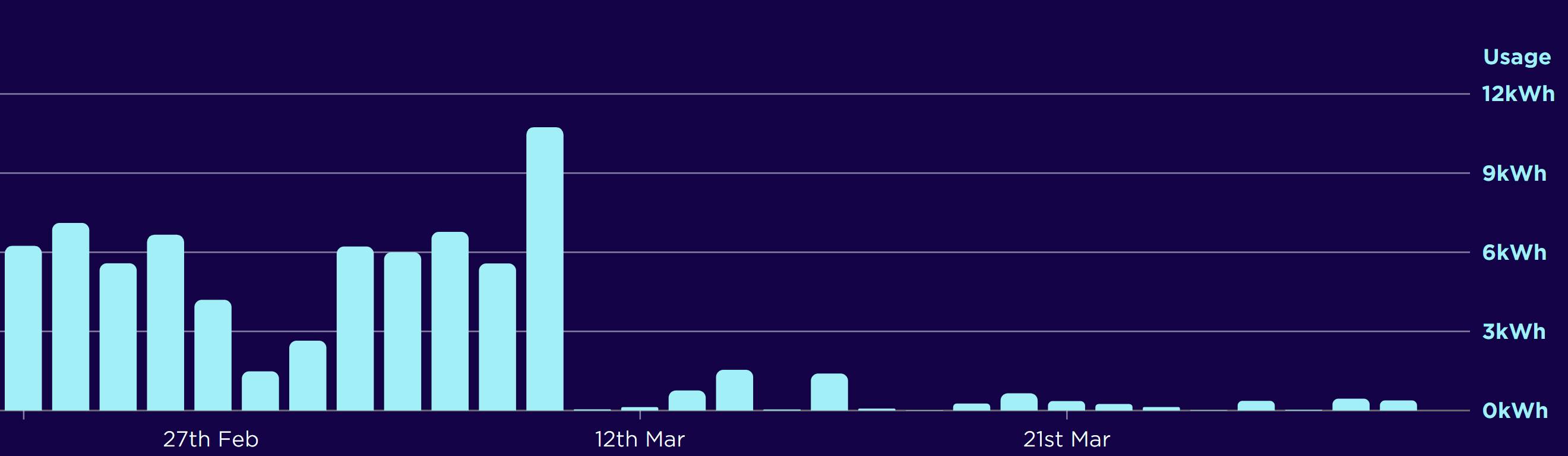
If you look at our energy usage I don't need to tell you when we had the system commissioned (they have to empty the battery and then fill it all the way to test it), and our first full day of solar. 

Even the days when the battery wasn't able to cover all our usage and we briefly drew from the grid (because we had too many appliances on at once or because it was slightly too slow to react), the usage was still lower than the day we were away from home (28th Feb). 

This was March - there should be plenty of surplus over the Summer months when days are much longer here in the UK. 

FYI - I'm not expecting to cover our usage from November to February, but might get a little extra power, we will see!  

Payback period? 

I signed up to this in order to reduce our carbon footprint, safe in the knowledge that it would be a good investment given that it would offer a saving on energy bills and that the panels would last at least 25 years (that is the warranty period). The inverter is unlikely to last that long, and the battery will start to degrade eventually, but they will pay themselves back too. 

It is hard to work out exactly when the "payback" period would be, because it would involve a lot of assumptions about future energy prices. 

The reason why I was very confident that it would be a good investment is because I've been following the climate and energy issues for a few years now and I'm convinced it is necessary to move to net zero (in fact I believe it should happy MUCH more quickly than our government is planning, given the reality and (im)morality of climate change). 

Self-use only?

The focus of the sales pitched when I ordered the system was on self-consumption. The idea is that you want to save yourself from importing electricity from the grid, which is expensive. 

However, I was keen to get more solar panels than most of the companies thought was sensible because:

  • Those of us with suitable rooves should be supplying clean energy to the grid
  • Energy prices could rise further
  • I want to offset my usage at other times of the year
  • I pay for offsets, so this is an extra saving that doesn't get factored in to payback calculations 
  • As renewables provide more and more of the electricity demand supply and demand will be 

Dynamic Pricing

However, since we ordered our system, Octopus Energy (a very forward-thinking company) have introduced a new tariff for people with solar and battery. 

This is a relatively dynamic pricing structure in that it varies at different times of the day. 

They already had some tariffs with cheap overnight prices (good for a home battery), but these were only available to people with an Electric Car and we haven't (yet) got one of those. 

Octopus Flux

The idea behind the new Octopus Flux tariff is that people with a battery can supply the grid during the evening peak period. 

The export rate is much higher than the paltry standard amount that focuses everyone on self-consumption.  

Now, I don't know if we will max out our battery every evening. Doing so might shorten the life of the battery. 

However, we have West-facing panels and I am hoping that they will be generating well into a Summer evening, and that we will be paid handsomely for that. Perhaps a few extra pounds on a sunny day, which would obviously reduce the payback period substantially. 

And part of the reason for wanting a battery is to ease the peaks and troughs that we place on the grid. After all, gas is always the source of the marginal (next additional) unit of energy (hence why gas sets the price). 

Essentially, in the months between ordering the system and getting it, I think that the expected returns have increased already as a result of this Octopus Flux tariff. We will be receiving several times the export payments I expected when ordering the system. It will pay itself back quicker than I expected.

The Future?

As part of the (absolutely necessary) move to net zero the following will be necessary:

  • Much more renewable energy for the electricity system
  • Electrification of transport (cars)  
  • Electrification of heating (heat pumps)
Demand for electricity will increase, while generation will be more variable.

In the future the above logic about marginal use should become more and more relevant, so that pricing better matches supply and demand.  

I expect that pricing will be even more dynamic than the Flux tariff. Price will also vary depending on supply of renewables and demand at that time. 

So rather than have pre-set times when the electricity is cheaper or more expensive it would vary depending on the amount of wind/water/solar electricity available and the demand of other users. 

People with batteries can shift their usage from the high-demand-low-supply times to the high-supply-low-demand times. They can, and should, be paid for doing this. 

Essentially, people who don't have batteries will have to pay more for their power, while people with batteries will be able to make use of cheaper prices.  

Solar helps with this because you are generating yourself, filling up your battery along the way. Having a battery makes sense with solar, but it also makes sense independently. 

Ready for net zero?

Essentially, if you are doing any kind of renovations to your house make sure you:

  • add solar panels as a lot of the cost is in the labour involved (the scaffolding, electricians etc.). The panels themselves are pretty cheap (about £200 - £300 each) and will pay themselves back in no time. 
  • insulate to as high a standard as possible to limit heat loss (electricity might be more expensive when it is very cold as everyone will have their heating on at once)
  • prepare for a high-efficiency heating system (a heat pump) by installing a low-flow system - underfloor heating or large radiators
  • have an electrical system that can cope with adding things like a heat pump, EV charging and battery in the future (though I was reassured it would be possible to extra things on even though our fuse board is now full).
Essentially, plan ahead for net zero! Renovations don't happen often and you don't want to have to do it again. Net zero has to come, and few houses are ready for it.