Wednesday, 5 July 2023

My courses for adults in 2023-4

My courses for the next academic year are now available to book. 

Click here for the latest version of the list of courses I am teaching, in date order. 

However, I thought I would list them here, so I can do so by format. 

Online Courses 

Political Philosophy: An Introduction (flexible online)
Flexible course with 24/7 discussion forums. Runs every term.
I am almost always the tutor on this course. 

Ethics: An Introduction (flexible online)
Flexible course with 24/7 discussion forums. Runs every term.
Mostly taught by other tutors, but sometimes I am the tutor.

Justice: Who Should Get What?
Mondays 3 - 4pm (UK time)
15 Jan - 25 Mar 2024 

The Ethics of Capitalism
Thursdays 1 - 2pm
18 Jan - Thu 28 Mar 2024 

Equality of Opportunity and the Ethics of Discrimination
Wednesdays 3 - 4pm
17 Apr - 26 June 2024 

Political Economy of Taxation
Thursdays 1 - 2pm
18 Apr - 27 June 2024 

In recent years I have also taught online courses over the Summer as well - look out for these in the new year.

Weekly Classes (10 weeks) in Oxford

Can Businesses be Ethical? What would this mean?
Fridays 2:00-4:00pm
29 Sep 2023 - 1 Dec 2023 

Can we achieve Net Zero if we are still addicted to Fossil fuels?
Tuesdays 7:00-9:00pm
23 Apr 2024 - 25 Jun 

Summer Schools (Oxford)

Ethics of Capitalism - Sat 3 Aug - Fri 9 August 2024 

I hope you will be able to join me on one or more of the above, and that you will tell anyone you know who might be interested! 

Sunday, 25 June 2023

Open Access Journal article on the duties of migrants to their past countries and the implications for taxation

 I'm very pleased that my paper: Duties in an International World: The Importance of Past Residence and Citizenship

Has been published in the open access journal Problema

This clarified my view, hopefully explaining and justifying my approach to the topic of international taxation that I had presented in earlier work. 

Essentially the idea is that people who leave a country and make a life elsewhere still owe something back to their earlier states. Their subsequent states of residence should honour this by sharing revenue as determined by a fair international formula. An exception arises for refugees who have been forced to flee.  

After publishing this article I attended a talk by Wolfgang Schön which made me think I have not covered this topic enough and should have said more about the duty of reciprocity, which is probably doing some work here. 

Anyway, I hope that some people find this paper interesting and useful and I look forward to reading reactions and responses to it. 

Sunday, 18 June 2023

"Tax Freedom Day" is complete nonsense

Apparently the Free Marketeers have declared today (June 18th) to be "Tax Freedom Day" in the UK.

The idea that people have been working for the government up to this point is really powerful - the nonsense of it all got me thinking of a completely different way of approaching taxation. 

Why not think of a "Tax Freedom minute" within the hour? This led me to develop my hourly averaging proposal, explained in my book Rethinking Taxation

Calculating "Tax Freedom"

If you do want to work out how much of your time goes to the government/society and how you get for yourself, then it would not just be be very difficult to do, it would actually be impossible. 

Think about it: 

  • How much does anyone "contribute" to society? 
  • How much does anyone "benefit" from society? 

If you want to use market prices for one you'd have to do so for the other as well. What is the value of the resources that each person receives over their life, from their families, government, employers and investment gains? I'll come back to this. 

When it comes to contribution things are even harder. 

  • Someone who follows the law (and its spirit) is contributing to society, while someone who doesn't is not. 
  • Someone who tends their garden thoughtfully and picks up litter benefits others, someone who litters and pollutes egregiously detracts.

How can you put a number on all these forms of contribution? 

Nagel and Murphy in their book The Myth of Ownership, showed this this whole line of thought is based on a simplistic everyday libertarianism. We assume that our gross income is in some sense ours as if we live in an imaginary libertarian economy. 

But we don't live in that economy. We live in our economy, in the real world. 

Tax isn't the only kind of contribution. However, it is an important one and everyone should be happy to pay their taxes out of a sense of reciprocity. 

Benefits received 

Of course, as I indicated earlier, what this "calculation" also misses is that we all benefit from government spending, past and present.

The government provides all sorts of goods and services that benefit us all. 

Some people, as is right, get more from the government than they put in. 

Children aren't going to be contributing, but all being well they will grow up and contribute later on. 

Some older people might not be contributing, but they will have done earlier in life.

If this was an honest exercise it would attempt to account for all the benefits that people receive over their life. 

It isn't an honest exercise, it is just libertarian propaganda that makes no sense. 

Net contributions?

Even if you think it is possible to calculate someone's tax contribution, and that it would be meaningful (which it isn't), the number would vary hugely from person to person.

Some people will get more than they contribute in ways that are right. We should want proper systems in place to support the vulnerable in society and not just abandon them.

Is it forgivable to spread nonsense?

You can criticize the supporters of "Tax Freedom Day" for being selfish, which is probably right. 

Or you can criticize them for being unrealistic ideologues, which is fair. 

But most importantly, they are also just talking nonsense in thinking that the numbers are in any sense meaningful.

People have got a right to be selfish, they have a right to believe and propagate nonsense.

It is a free country after all. 

The rest of us have a duty to see through it all. 

Wednesday, 19 April 2023

Advice for getting solar systems in the UK

 A few people have asked me for advice about getting solar panels since I posted about our newly installed system. 

There is lots of general advice out there, and installers will of course look at your particular situation. 

For instance, Artisan Electrics has a video with good advice on the topic, which mentions a lot of the practical considerations. 

There are lots of things to think about, like what roof you have and whether it is in the shade at all. Having some shade isn't a dealbreaker (you can always get a micro-inverter for each panel), but you could have a look at your roof at different times of the day to see whether any nearby trees or rooves cast shade.  

Essentially, you want to get an MCS approved installer. They have to abide by high standards and only MCS installed systems can generate export payments. You certainly want to get paid for your excess if you are having a large system installed.  

I found the sales people generally quite useful for reviewing the options and coming up with a proposal they believe is in your financial interest, based on their own assumptions. 

However, there are a few things that installers might not flag up to you.  

Future proofing? 

As I mentioned in my previous blog, the focus tends to be on covering self-consumption. This is because you can be sure that you will save money on your electric bill if the solar (or solar and battery) covers that. 

After all, the export payment rate has been very low in recent years, so there has been little incentive to use your roof to supply the grid. 

However, there is no way to truly work out the payback time for a solar system - it depends on too many unknown future factors. How much will your electricity bills be in the future? What will your demand be? What will the export price be? Nobody knows for sure - certainly not me!  

Higher rates in the future?

However, that might not always be the case. New tariffs like Octopus' Flux tariff are offering rates several times that of the longstanding (but paltry) Standard Export Guarantee. However, these higher rates aren't guaranteed and the entire tariff might be withdrawn at any point. 

Nevertheless, if you look at all the plans to build solar farms and the controversy raised about them, it seems like using rooves is much less controversial. If all rooves were covered in solar and every house had a battery it would really help the country continue to run on clean energy through windless days after all. 

I certainly can't guarantee what export rates will be in the future, but I expect that if you've got a battery you will be able to use this for energy arbitrage - buy when the price is low and sell when it is high. 

Higher electricity consumption in the future?

But the other reason to think beyond your current use is that your use might increase in the future. 

Obviously, we are all looking to get more energy efficient as time goes on. LED lightbulbs use a fraction of older types for instance. 

However, that is just part of the story. The other side of net zero is that we need to electrify energy previously provided by fossil fuels. In the UK that means that your car, heating and hot water will be electric (the latter two ideally with a heat pump). 

These will require a lot of electricity to replace the petrol and gas. The usage won't necessarily perfectly line up with solar production - your car might be out in the middle of the day in the summer and your heat pump will be working much harder in the colder winter months when the solar production is much lower.

Nevertheless, having your own generation to assist in these things will be useful, and the case for a home battery and solar will increase the more that your activities are electrified.

More or less? 

Overall - my feeling is that you can't really have too much solar generation (unless you have a REALLY huge roof that could fit loads of panels).    

Of course, you can add to your system later. There is a case for getting something to start with and building from there. However, a lot of the cost of installing a solar system is the labour and scaffolding rather than the number of panels (which are about £200-£300 each)

I am glad I pushed for a slightly larger system (16 panels when a lot of the quotes were for 20), though I now wish I had budget for an even larger one. 

Too small an inverter? 

I've given one reason why you might be pushed towards too small a system. 

One thing to be aware of is that the regulations have created an incentive for installers to install smaller inverters, which might also push them to recommend fewer panels for your system.

The inverter is the crucial part of any solar system - it converts the DC power from the panels to the AC power used in your house and the grid. 


When installing the system it is necessary to inform the local Distribution Network Operator (DNO). There is a process to do this. 

For a smaller sized inverter (under 3.68kw) it is only necessary to inform the DNO of the installation (G98). 

Over 3.68kW?

For a medium or large inverter the installer has to seek approval (G99). Any decent company should include this service. 

However, this process takes time and the outcome is not guaranteed - you might be told that the local network cannot cope until it gets upgraded in the distant future, or, that your own supply line needs to be upgraded (though this is unlikely unless you are having a lot of panels installed). 

More importantly, as well as time spent on the process, it also costs money - companies have to pay to go through this process. 

For this reason, it is conceivable that companies would push customers towards a smaller system, of around 12 panels or fewer, even if they would do well to get a larger one. 

Essentially, this regulation has created an incentive for installers to propose solutions of a particular size. I expect that many people will end up with systems sized at this level because of this regulatory quirk. 

Fortunately, although I wasn't really aware of this issue when I ordered my system, I did notice that a 5kW inverter had some advantages of a 3.68kW one AND was virtually the same price. I therefore mentioned this to my installer, who agreed to install the 5kW. 

This was a risk for the installer, but I have got a much more appropriate system as a result. 

Plus, if I do add a few more panels in the future the inverter will be able to process the higher peak energy created, which a smaller one wouldn't manage. 

Final thoughts

Overall, I am a huge advocate of solar systems for climate mitigation reasons, but they also make a lot of financial sense.

There is a lot of good advice out there from people who know their stuff. There are several You Tube channels on the topic such as Gary does solar and Tim & Kat's Green Walk

Most installers will give you good advice and consider the relevant factors. 

However, I wanted to flag up a few things that might lead installers to push people away from using their roof to its ideal solar potential. 

Monday, 10 April 2023

Good video explainers of Climate Change

Someone on twitter once asked me for good videos on climate change.

I didn't have a great answer then, but I think I would now. 

A simplistic understanding?

I recently watched some videos that demonstrated that I, like most people, had the sort of 'high-school' level understanding of climate change. 

Sabina Hossenfelder is a top physicist and she recently admitted she had just the basic understanding until recently. In a recent video she explains the basic and more accurate versions


Denialist tricks

You'll notice that climate science deniers are often very adept at challenging the simplistic 'school-level' version of climate change. 

They often make claims about climate science that no scientist would support or believe, like that carbon dioxide is the only thing that affects the climate. However, their demonstrations that CO2 isn't the only thing that matters does not debunk the key claim which is that our CO2 emissions are having a serious impact.  b

Denialists aren't engaged in honest science - they simply cherry pick anything that appears to support their pre-determined agenda. They are driven by politics rather than science. 

We have clear evidence that the Earth has been warming in recent decades. Denialists can't deny this any more, so they have to come up with other explanations for the warming - often that it is due to the sun. 

Simon Clark has a very good video explaining why the sun CANNOT be behind global warming


I think this was the video that helped me to understand the point about how climate change really works. The warming of the atmosphere due to the greater amount of CO2 (and other GHGs) puts the system out of balance. Since it isn't possible to emit all that extra energy out to the void of space it has to come back down to Earth. 

It is no doubt hard to know for sure what impacts all that extra heat energy is going to do, but it seems hubristic to think that adding a load of heat to finely balanced systems around the world is going to work out well.

A very good lecture

For a very straightforward (and well-produced) full lecture explaining climate science I can recommend Myles Allen's Gresham College lectures, particularly The Atmospheric Physics Behind Net Zero


Do add further suggestions below! 

Friday, 31 March 2023

We've gone solar! Should you?

Last Summer I discovered that having an East-West facing roof didn't make solar panels pointless after all, and so we found a company to install them (don't worry Mum - we got three quotes). 

Anyway, after a lot of delays we got the system installed three weeks ago.


System capacity

For those interested in the details it is sixteen 395w panels (two strings of 8) with a 5kw inverter and a 9.5kwh battery. 

We also had a smart immersion heater installed into our hot water tank. Well, not that smart - it doesn't do solar divert. But that doesn't matter because the battery can make up any difference if there isn't enough solar at the precise moment we are heating the water. The aim here is to stop using gas for half the year. 

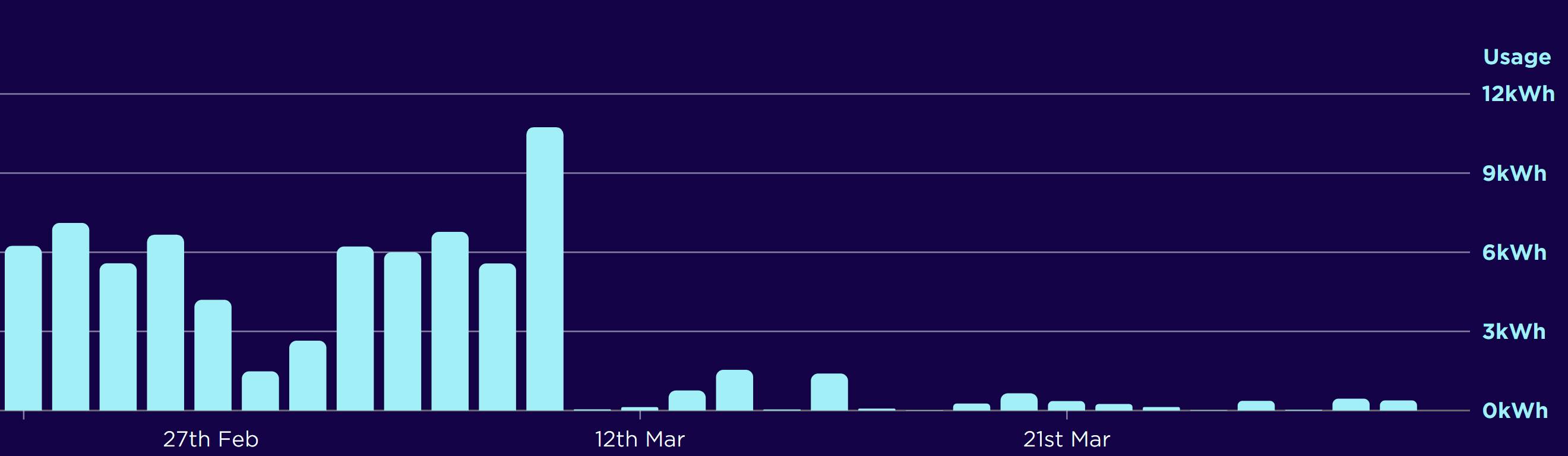
In the three weeks so far (in March) we have been almost entirely self-sufficient for electricity and hot water. 

If you look at our energy usage I don't need to tell you when we had the system commissioned (they have to empty the battery and then fill it all the way to test it), and our first full day of solar. 

Even the days when the battery wasn't able to cover all our usage and we briefly drew from the grid (because we had too many appliances on at once or because it was slightly too slow to react), the usage was still lower than the day we were away from home (28th Feb). 

This was March - there should be plenty of surplus over the Summer months when days are much longer here in the UK. 

FYI - I'm not expecting to cover our usage from November to February, but might get a little extra power, we will see!  

Payback period? 

I signed up to this in order to reduce our carbon footprint, safe in the knowledge that it would be a good investment given that it would offer a saving on energy bills and that the panels would last at least 25 years (that is the warranty period). The inverter is unlikely to last that long, and the battery will start to degrade eventually, but they will pay themselves back too. 

It is hard to work out exactly when the "payback" period would be, because it would involve a lot of assumptions about future energy prices. 

The reason why I was very confident that it would be a good investment is because I've been following the climate and energy issues for a few years now and I'm convinced it is necessary to move to net zero (in fact I believe it should happy MUCH more quickly than our government is planning, given the reality and (im)morality of climate change). 

Self-use only?

The focus of the sales pitched when I ordered the system was on self-consumption. The idea is that you want to save yourself from importing electricity from the grid, which is expensive. 

However, I was keen to get more solar panels than most of the companies thought was sensible because:

  • Those of us with suitable rooves should be supplying clean energy to the grid
  • Energy prices could rise further
  • I want to offset my usage at other times of the year
  • I pay for offsets, so this is an extra saving that doesn't get factored in to payback calculations 
  • As renewables provide more and more of the electricity demand supply and demand will be 

Dynamic Pricing

However, since we ordered our system, Octopus Energy (a very forward-thinking company) have introduced a new tariff for people with solar and battery. 

This is a relatively dynamic pricing structure in that it varies at different times of the day. 

They already had some tariffs with cheap overnight prices (good for a home battery), but these were only available to people with an Electric Car and we haven't (yet) got one of those. 

Octopus Flux

The idea behind the new Octopus Flux tariff is that people with a battery can supply the grid during the evening peak period. 

The export rate is much higher than the paltry standard amount that focuses everyone on self-consumption.  

Now, I don't know if we will max out our battery every evening. Doing so might shorten the life of the battery. 

However, we have West-facing panels and I am hoping that they will be generating well into a Summer evening, and that we will be paid handsomely for that. Perhaps a few extra pounds on a sunny day, which would obviously reduce the payback period substantially. 

And part of the reason for wanting a battery is to ease the peaks and troughs that we place on the grid. After all, gas is always the source of the marginal (next additional) unit of energy (hence why gas sets the price). 

Essentially, in the months between ordering the system and getting it, I think that the expected returns have increased already as a result of this Octopus Flux tariff. We will be receiving several times the export payments I expected when ordering the system. It will pay itself back quicker than I expected.

The Future?

As part of the (absolutely necessary) move to net zero the following will be necessary:

  • Much more renewable energy for the electricity system
  • Electrification of transport (cars)  
  • Electrification of heating (heat pumps)
Demand for electricity will increase, while generation will be more variable.

In the future the above logic about marginal use should become more and more relevant, so that pricing better matches supply and demand.  

I expect that pricing will be even more dynamic than the Flux tariff. Price will also vary depending on supply of renewables and demand at that time. 

So rather than have pre-set times when the electricity is cheaper or more expensive it would vary depending on the amount of wind/water/solar electricity available and the demand of other users. 

People with batteries can shift their usage from the high-demand-low-supply times to the high-supply-low-demand times. They can, and should, be paid for doing this. 

Essentially, people who don't have batteries will have to pay more for their power, while people with batteries will be able to make use of cheaper prices.  

Solar helps with this because you are generating yourself, filling up your battery along the way. Having a battery makes sense with solar, but it also makes sense independently. 

Ready for net zero?

Essentially, if you are doing any kind of renovations to your house make sure you:

  • add solar panels as a lot of the cost is in the labour involved (the scaffolding, electricians etc.). The panels themselves are pretty cheap (about £200 - £300 each) and will pay themselves back in no time. 
  • insulate to as high a standard as possible to limit heat loss (electricity might be more expensive when it is very cold as everyone will have their heating on at once)
  • prepare for a high-efficiency heating system (a heat pump) by installing a low-flow system - underfloor heating or large radiators
  • have an electrical system that can cope with adding things like a heat pump, EV charging and battery in the future (though I was reassured it would be possible to extra things on even though our fuse board is now full).
Essentially, plan ahead for net zero! Renovations don't happen often and you don't want to have to do it again. Net zero has to come, and few houses are ready for it. 

Thursday, 2 February 2023

Free Speech: free online materials

I’m pleased to be giving two talks on the upcoming Day School The Limits of Free Speech: Offence, Hate Speech and No Platforming on Saturday 25th of February 2023.

I thought I would put up some online resources that would be useful to anyone looking to attend the event.

Free online reading

Background reading on Freedom of Speech

van Mill, David, "Freedom of Speech" in Zalta (ed.) The Stanford Encyclopedia of Philosophy (2021)

Anderson, Luvell and Michael Barnes, "Hate Speechin Zalta (ed.) The Stanford Encyclopedia of Philosophy (2022)

Bonotti, Matteo, and Jonathan Seglow. "Freedom of expressionPhilosophy Compass 16, no. 7 (2021): e12759.

If you want to buy a short introductory book, I recommend Nigel Warburton's Free Speech: A Very Short Introduction

JS Mill's classic (and very readable) text On Liberty (1859) is available cheaply, but as it is out of copyright you can view it online (also see below for a free the audiobook)

More advanced readings

I’ve noticed that a lot of the works of Alexander Brown, an author in this area, are available free online. If you want to read something more advanced you could read one of his papers, or his book.

Videos

There are lots of videos online discussing liberty, free speech and hate speech.

Two authors for whom I have a lot of respect, Jeremy Waldron and Ronald Dworkin presented their contrasting views on the issue of hate speech in 2013. Links here.

Audio

(listen online or download to your podcast app)

Audiobooks

Some people have kindly recorded J.S. Mill’s On Liberty (1859) as an audiobook

Nigel Warburton reads the Chapter John Stuart Mill on Liberty from his book Philosophy: The Classics.

Podcasts

Tim Scanlon on Free Speech Philosophy Bites (2008)

Rae Langton on Hate Speech Philosophy Bites (2012)

Caught between free speech and hate speech Big ideas (2018)

Jacob Mchangama Clear and Present Danger - Free Speech Podcast (Many episodes!)

Freedom of Speech: Censors working overtime Origin Story (2022)

Controversial Ideas and “No Platforming” with Jeff McMahan Why we argue (2019)

Deplatforming Jurisprudes (2022). 

Political Philosophy and liberty

These materials also provide a useful background to the online short course Political Philosophy: An Introduction, which I often teach.

This 10 week course runs three or four times per year.  

Liberty is one of the topics covered. We look at JS Mill’s harm principle and whether and how you it applies to various cases.

I hope to see you on one or both of the courses above!