Sunday, 14 July 2024

Holiday journey with an Electric Car

A few months ago we bought what was - at the time - the cheapest BEV car available. 

By car I mean a proper car that you can drive anywhere like on the Motorway, not a quadricycle or anything like that. 

There are now some cheaper ones available for sale on pre-order, with less good features, but the point remains that our car isn't a special one with long range or anything like that. It is just a basic/standard EV.

We have a driveway and can charge the car at home, which is very convenient. 

The car has a range of about 200 miles, which is fine for almost all of the journeys that we do. 

The only exception is where we go on our annual holiday. We book a cottage somewhere in the UK, and for these trips the journey there and back will certainly exceed the range of the car. 

Since we have just had our first such trip (to Pembrokeshire) I thought I would write up the experience. 

Part 1: Trip to Wales (Pembrokeshire)

We started with the car at 100%. 

The cottage we were staying at was just out of the reach of the car. Well, perhaps we could have made it driving very economically. But we didn't want to take the risk, so had to stop to charge on the way. 

When going to stay at a cottage we always stop at a supermarket on the way to pick up our supplies and so I looked for a supermarket with chargers nearby. 

Tesla have opened some of their chargers up to non-Tesla owners and they are much cheaper than rival companies, so they are an appealing option. 

I found a Tesla location near a Lidl on the edge of Cardiff so we headed there. Katy did the shopping while I charged the car. 


While the car was plugged in I managed to have my flask of tea, take the dog for a little walk, and still get back to the Lidl before Katy had finished shopping. 

22 minutes charging. 

17kwh of electricity for £6.97.

Charging at the destination 

The best time to charge is while you are doing something else, like sleeping, eating or shopping. 

We booked a cottage which had an EV charger so that we could charge easily enough while parked. 

From this charger we took on 41kWh for £19.90 and then (before leaving) 6.92kWh for £4.44. 

It was a bit disappointing that we had to download an app, and that the cost was similar to the (much faster) Tesla charger. Also, there was a fee to connect and also an idle fee - a fee for having the car plugged in while fully charged. To me that didn't make sense on a slow charger in the middle of nowhere on private land, but that is the deal that the owner signed up to. 

It turned out there were plenty of chargers in car parks we visited so we could have probably got away without booking a cottage with a charger, but it made planning easier and it was one less thing to worry about.  

At any rate, it worked and we filled up the car during the stay.  

Good job that we filled up too as we used the car most days to go out for walks in the surrounding area. 

Journey home 

Disappointingly my attempt to leave with 100% was thwarted because for some reason the charger did not charge at its full potential. Plus we packed up and left a little earlier than planned, so we left with 85% charge instead of a full battery. 

We aimed for a Tesla charger at Newport (Celtic Manor Resort car park) and arrived with plenty of contingency in case we needed to travel on to the next set of chargers for some reason. I had alternative options planned - Ionity chargers that were more expensive but which I could have paid for out of our Octopus home energy account credit surplus.  

Only 17 minutes of charging, and again took on 17kwh of electricity. This time it cost £7.14.

It took less time to get the 17kwh, probably because the battery was at a lower percentage when we arrived. EVs often charge fastest when they are nearly empty.

The A Better Route Planner (ABRP) App indicated that we needed to charge to 68% to arrive home with 10% left (which I wanted to do to provide some contingency).

We had our hot drinks and snacks in the car and then stretched our legs.    

Katy was still walking the dog when I disconnected the charger because we reached our target of 68% battery, so I then had to wait for them to return. 

We arrived home with 18% battery left so it turned out that charging to 68% was not necessary. 

I think this was because I got better efficiency from the car than ABRP assumed. I got 4miles per kWh which is very good for an MG4 doing motorway driving. I just set the Adaptive Cruise Control to 68mph and let the car do the rest, except when there was some overtaking to do when I might have tickled the accelerator to exceed 68mph. 

Summary

Overall, my summary would be the following: 

  • It is perfectly fine to do a long journey in a standard MG4 in the UK. It doesn't have a huge battery or super-fast charging speeds but it has enough of both to be perfectly suitable. 
  • You may still need to do a bit of planning before going on a road trip with an EV in the UK. Look for rapid chargers on the route, ideally Tesla or others which are cheap, reliable and fast. But there will probably be several suitable options along the route.
    Don't leave yourself with only one option in case it is full or broken when you get there! 
  • Tesla chargers are great - no problems at all with the Tesla app (set up with payment card in advance). Lots of other Tesla's there and a couple of other brands of car as well (Volvo, Mercedes).
  • It would be good to have more charging options off the motorway. As time goes on there will be more options and they will hopefully then get cheaper due to competition, meaning less planning is required. 
  • The more people buy electric cars the more incentive there will be for companies to build new rapid chargers for them. 

The total cost of charging away from home was £38.45. That would have bought us about 225 miles of petrol in our old hatchback, and we will have got well over 300 miles of driving from the electricity. 

So even on the worst case scenario - charging away from home - it is cheaper to drive an EV than a petrol car. And it is much cheaper to charge at home using our solar panels, which we do for the rest of the year. 

So the only real downside of having an electric car turned out not to be a problem at all!

Thursday, 16 May 2024

Climate realism?

Physicist and Science communicator Sabine Hossenfelder has been typically blunt about the distance between the plans and the reality when it comes to decarbonisation in a recent video Time to Get Real about Climate Change.

Links to an external site.
Personally I am concerned that we will shift from ignorance/disinformation-based apathy to doom-based apathy. 

It would have been much easier to stick to 1.5 or 2 degrees of warming if people had taken the issue seriously in 1989, 1999, 2009 etc. 

The longer you leave it the harder it becomes. 

It is now VERY hard, yet we still get huge amounts of disinformation.

I can see why people become doomers but I think that is a complete cop-out and too easy. 

What is clear is that absolutely huge amounts of low/zero-carbon power are urgently needed, whether that is to replace fossil fuels or sequester historic emissions and both are urgently needed. 

So let's get on and build that as a matter of urgency - things can be done quickly if there is political will. We wasted too many decades already. 

Monday, 11 March 2024

First year of solar generation

 We had out solar and battery system installed a year ago and so I thought I would share the stats! 


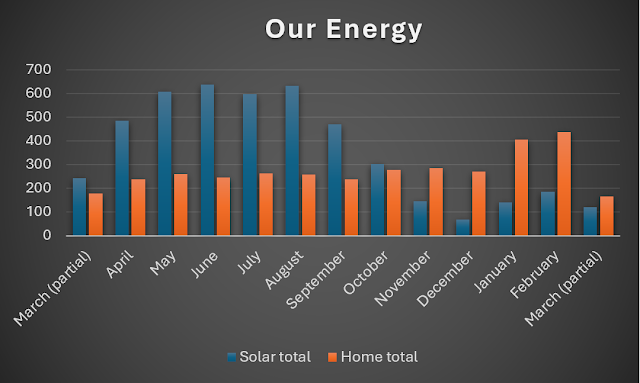
Yes, we generated 4.64 MWh and we used 3.2 MWh, meaning a surplus of 1.4MWh! 

We got a BEV recently, though, which will use up a lot of that difference in the future. But we have about 4k miles worth of spare capacity there. 

Here is the usage and generation broke down month-by-month. Big surpluses from April to September, March and October are break-even months, and November – February we are in deficit. 

Not too surprising given that we have an East-West roof rather than South-facing. 

We had some data connection issues in November and December so for those months the data might be a bit lower than it should have been, but not by a huge amount. 


Graph of solar generation and home electricity usage


What are the conclusions? 

I'd say "get as many solar panels on your East/South/West facing rooves as they can fit."

We need to switch over to renewable electric energy ASAP, and to "electrify everything" in order to "stop burning stuff." 

I kind of wish we could have crammed a few more panels on there, given that the panels themselves are pretty cheap and a lot of the cost is the electrical work. However, we had a budget at the time. 

Monday, 1 January 2024

Alabama introduces complicated hourly tax system

 I've been very intrigued by a newly introduced tax calculation in Alabama.  

A lot of the information I've found about it comes from law firms, who are no doubt explaining it in order to encourage businesses to hire them to make sure that they are compliant. 

How does it work? 

As well as any federal income taxes, Alabama charges income tax at 2% to 5% on a progressive basis. 

Don't rely on my simple explanation here as legal advice, but here goes!  

The new law proposes that workers who are performing more than their contracted hours, which in turn are over 40 hours, will not pay the Alabama income tax on that income. 

So the workers will only pay federal tax on their overtime work. 

They will still pay the Alabama tax on their standard hours, but not on their overtime.  

So their tax rate will still be 5% on some of their earnings (say if they work 39 hours), but then drop to 0% for earnings representing overtime hours.

So for someone who works 45 hours they would have 40 hours of earnings at the standard state-tax-rate and 5 hours of earnings that are state-tax-free.  

Benefits of the system 

The advantage of the system is that workers will face a lower marginal tax rate when offered overtime work than they would do normally. 

This can be achieved without lowering the standard rate of tax (5%) which would of course completely erode the tax revenues. 

I think from Alabama's perspective the aim is a form of tax competition - set up your business here and your workers will be more likely to accept overtime work. 

I expect there is also an expressive element as well - "hard workers shouldn't pay more tax as a result of their striving." 

But in economic terms, the aim as I've noted above could be framed more technically in terms of marginal tax rates. Progressive tax rates discourage high earnings, whether that comes from working more hours or from doing higher-paid work. 

Disadvantages of the system 

It might seem to be a lot of trouble to go through to provide a 5% reduction in marginal tax rates. If the system was applied on federal income tax it would of course be much more impactful, but Alabama can only change its own state tax rules, not those of the US government. 

There will be compliance issues in order to assure that the system is not being abused. Firms will have to do extra reporting, and be expected to apply the new tax rates to their workers (and not just claim and pocket the tax refund themselves). Hence why law firms are offering their assistance. 

Even though employers take on the administrative burden of income tax, the Alabama state tax administration will presumably have extra costs as well. The tax authorities are going to have check the claims by employers to make sure that they are not fraudulent.

The state needs to know a) How many hours workers are contracted to work and b) how many hours they have actually worked. If they have this information they could apply my hourly averaging system (see below).   

Another concern is that this might concentrate work into fewer hands - employers will hire fewer employees and work them longer hours. This seems a strange thing for a state to subsidise. Surely they would want to have more workers employed overall? Presumably the thought is that other firms will set up in Alabama and have their overworked Alabamans provide goods to other states. 

Why not go all the way? 

This Alabaman system is very interesting to me because it is trying in a very crude way to do the thing that my Hourly Averaging system is doing: to tax people who work more hours at a lower rate than those who work fewer hours. 

If the aim is to incentivise work then why not go all the way and impose an hourly average tax calculation? 

The Alabama system does not incentivise part-timers to increase their hours. Or incentivise the early-retired to return to work. 

My proposal is that everyone should have their lifetime income divided by their lifetime hour credits. These hour credits represent the number of hours the person has worked (or been excused from working if they suffer ill-health). This average is used to determine that person's lifetime tax rate, which is in turn used to work out their tax rate on their most recent portion of income. At each point the person will have paid the correct lifetime amount of tax and received the correct  

Such a calculation can be fully progressive - low earners who work long hours at a low wage will have a low tax rate (perhaps even negative with an hourly subsidy). High earners who work short hours  (say a part-time lawyer) would have a higher tax rate. 

Everyone has an incentive to work more, with one difference. 

I proposed a maximum number of hour credits, beyond which point people do not get any further reduction in their tax rate. This is an optional part of the system, but I proposed it for a few reasons:

  1. To avoid incentivising overwork 
  2. To reduce the potential for fraud
  3. To avoid incentivising the concentration of work within each enterprise. A long-hours option for some and few/no work options for others. 

The maximum hours proposal is not key to the system but I think it is a good idea. Alabama are sort of doing the opposite here - Alabama are only applying the hourly tax reduction ABOVE a high threshold. 

Will 2024 be the year Hourly Taxation starts to gain traction? 

I will be watching the Alabama system with interest! 

If a Conservative state can make hourly taxing work then I don't see why my progressive version cannot be seriously considered. 

The potential administrative issues are the big barrier to the implementation of my hourly tax proposal (along with ideological opposition from free marketeers and top-down-statist socialists, and concern about international tax competition).  

Will 2024 will be the year in which hourly taxation finally gets taken seriously? I certainly hope so! 

Sunday, 15 October 2023

Givenergy Inverter Error: Electricity Meter Com Fail

 I had a problem with my Givenergy Inverter and I thought I would share my solution as I could not see anything about it online. 

It wasn't a huge problem, but it was a little annoying when you are an energy geek like me. 

Essentially, the inverter stopped providing data to the cloud and therefore I could not see what was happening on my givenergy webpage or the phone app. 

It was disconcerting as I could not see what was happening and whether the battery and solar were working or not, let alone how they were performing. For all I knew they had shut down and it might have been dangerous. 

Photo of Consumer unit with fuses, including one with a green display and button.

What caused the error?

I think the error occurred when I turned off the lighting circuit next to this one in order to change some lightbulbs (see photo). 

I later realised that I wasn't getting any readings from the inverter.

What form did the error take?

There was no data being received about the energy going in and out of the meter. 

Looking into the reports on the web portal, there was a new error "Electricity Meter Com Fail." 

The inverter lights were on, which was reassuring, but the circle of light in the middle was yellowish, which I later learned indicates a communication problem. 

I could not see any advice about how to fix this issue online and so I tried a few things.

Eventually I went to bed defeated as it was nearly 1am and I wasn't getting anywhere.  

In the morning I continued to look up the problem and what it might be.  

I was getting battery data but not solar and grid data. I found the smart meter device to check if it was exporting. (I never use this device because the inverter provides much more useful data via givenergy). 

Simple solution

I believe I solved the problem by doing the following:

  • Pressing the set button on the electronic meter in the consumer unit. I did this last night and it did not achieve anything. 
  • However, today I also held down the button for a few seconds. This seemed to get the device to go through some sort of process and afterwards the readings resumed. 

So there you go - as simple as pressing the button on there to get it to reset itself. 

Phew! 

So the system was seemingly working throughout. I only missed about 18 hours of data collection on the solar generation and grid import/export but the electricity company will have been measuring my import and export so the data is just for my own records. 

However, it was quite a worry that there was a problem with the system over the weekend and that I might have to contact givenergy or my installer to get advice, possibly facing a callout charge or something. 

All in all, it has worked out fine, but I wanted to save others the stress by suggesting what might be a simple solution to a frustrating and disconcerting issue.  

Wednesday, 4 October 2023

Cars in 2045: Offsetting Petrol/Gasoline costs with Carbon Capture and Storage

Why should we switch our entire fleet of cars over to Battery Electric Vehicles over the course of the coming decade? 

Photo of Two Battery Electric Vehicles

Isn't that going to be a huge pain? 

Shouldn't we just let people carry on using petrol cars? 

Well, let's try and work this out. 

Net zero future

We are in 2040 or 2050 and in urgent need to get to net zero because we have done so little about climate change up to that point. The global temperature is now on average 2 degrees over the pre-industrial average and still rising. 

Finally the governments of the world agree they have to achieve net zero after all by belatedly charging the full cost of carbon pollution. But how much will that add to the cost of petrol? 

I've tried to work this out, based on rough current prices, but I'm happy to be corrected if I've got something wrong. 

Invisible pollution caused by burning petrol/gas

We can't sense CO2 of course, but burning a litre of petrol apparently produces an astounding 2.4 kg of CO2! 

Furthermore, we have to add in the emissions involved in producing the petrol in the first place. I will estimate this to be an extra 0.72kg at present. 

But maybe that amount will come down if refineries and oil tankers use renewable power in the future? So let's assume pollution from petrol production has improved to 0.6kg per litre. 

This makes a nice round number of 3kg of CO2 per litre. 

Offsetting the CO2 pollution

What are the options to offset this CO2? All the cheap options - growing trees and plants and so on - will be long used up by this point. Let's say the airlines have already bought all these up and there is no land left for this. 

This leaves Direct Air Capture of Carbon and Storage (DACCS). It is hard to predict how much DACCS will cost in the future. It is completely unproven technology. Plus we don't have places to reliably store all the carbon produced, but let's ignore this for now and assume we can use it for something or put it back in the wells which we emptied of oil and gas for the same cost as getting that oil and gas out. 


Photo of a carbon engineering plant

At the very least the DACCS machinery would need to be powered with spare renewable capacity, since powering it with fossil fuels would mean you would also have to "CCS" those emissions, which would require burning more fossil fuels, which would require more CCS. So you need to build extra renewables to cover this usage. Let's assume you've overbuilt renewables and run the DACCS machine whenever there is a surplus. 

Nobody has any idea how much this will cost, but the IEA believe - no doubt correctly - that some CCS will be inevitable and have provided some estimates. Optimists say it will be $100 per tonne. Pessimists that it would be $350. I'm pessimistic myself, but let's consider those two scenarios to get an idea. 

Do we want to continue to using petrol and "DACCS" it or do we want to switch to BEVs? Let's consider the extra cost of capturing the carbon from petrol. 

Cheap DACCS cost of offsetting Petrol

DACCS cost per tonne of CO2: $100

DACCS cost per kg of CO2: $0.10

DACCS cost per litre of petrol: $0.30 (£0.25 at current exchange rates)

Expensive DACCS cost of offsetting Petrol

DACCS cost per tonne of CO2: $350

DACCS cost per kg of CO2: $0.35

DACCS cost per litre of petrol: $1.05 (£0.86 at current exchange rates)

Conclusion

As I've said, I am pessimistic that DACCS will come down significantly in price. It will probably end up somewhere in between those two extreme guesses. 

There is also the issue of what you do with all this carbon. I've added in some costs to transport it, but transport it to where? Presumably to make some E-fuels or something. Then the question is whether you should also DACCS the e-fuels as well? Or should the user of those e-fuels be responsible for that? 

Either way, imagine that the cost of petrol, whatever it would be in 2045 or 2050 (when peak oil might have hit anyway) is supplemented by a DACCS charge of fifty pence or more. 

BEVs are already cheaper over their lifetimes than petrol cars due to their lower fuel, running and maintenance costs. 

How much do you value your petrol car over the BEV alternative that you would pay this premium? Let's face it, few will. Petrol cars will be historic curiosities. There will be plenty of enthusiasts. However, they will be seen as inefficient, wasteful, dirty and polluting compared to normal cars (BEVs) 

Wednesday, 5 July 2023

My courses for adults in 2023-4

My courses for the next academic year are now available to book. 

Click here for the latest version of the list of courses I am teaching, in date order. 

However, I thought I would list them here, so I can do so by format. 

Online Courses 

Political Philosophy: An Introduction (flexible online)
Flexible course with 24/7 discussion forums. Runs every term.
I am almost always the tutor on this course. 

Ethics: An Introduction (flexible online)
Flexible course with 24/7 discussion forums. Runs every term.
Mostly taught by other tutors, but sometimes I am the tutor.

Justice: Who Should Get What?
Mondays 3 - 4pm (UK time)
15 Jan - 25 Mar 2024 

The Ethics of Capitalism
Thursdays 1 - 2pm
18 Jan - Thu 28 Mar 2024 

Equality of Opportunity and the Ethics of Discrimination
Wednesdays 3 - 4pm
17 Apr - 26 June 2024 

Political Economy of Taxation
Thursdays 1 - 2pm
18 Apr - 27 June 2024 

In recent years I have also taught online courses over the Summer as well - look out for these in the new year.

Weekly Classes (10 weeks) in Oxford

Can Businesses be Ethical? What would this mean?
Fridays 2:00-4:00pm
29 Sep 2023 - 1 Dec 2023 

Can we achieve Net Zero if we are still addicted to Fossil fuels?
Tuesdays 7:00-9:00pm
23 Apr 2024 - 25 Jun 

Summer Schools (Oxford)

Ethics of Capitalism - Sat 3 Aug - Fri 9 August 2024 

I hope you will be able to join me on one or more of the above, and that you will tell anyone you know who might be interested!