Saturday, 7 February 2026

Is Willowbrook Park a Sustainable Urban Development?

 In 2025 I undertook the course Sustainable Cities: An Introduction taught by my fantastic and friendly colleague Dr David Howard. I wanted to share an updated version of the assignment from the course online in case anyone found it interesting.

Is Willowbrook Park a Sustainable Urban Development? 

Introduction

This essay reviews the sustainability of one of the ongoing green-field developments to the North-East of Didcot. Willowbrook park is one part of a major development of around 2,000 homes to the North of Didcot, being delivered by Croudace homes, alongside two other developers. Willowbrook Park was begun before the other developments and is nearly complete, with most sections built and inhabited. The wider development is part of a major extension of Didcot as part of the Didcot garden town masterplan (South Oxfordshire Council, 2017).

The developer claims that “Ecological and environmental aspects of construction are of the utmost importance” (Croudace homes, 2025a: 4). To assess this claim, I will first give an overview of the development in question and its context, provide a working definition of sustainability and then discuss how well the development fares according to the three pillars of sustainability. I will focus mostly on the environmental pillar.

Context

The extension of Didcot takes place in order to meet the acute housing need in Oxfordshire arising due to economic success and rapid population growth. South Oxfordshire has been the focus of a lot of job and housing growth, particularly arising due to research developments at Harwell, Culham and Oxford. As there are green belt restrictions around Oxford, Didcot has been the focus of housing growth due to its location.

Figure 1 Map with Didcot, Railway lines and Location of development marked with an X.

Didcot grew into a town as it is the junction station where the Oxford branch line deviated from the Great Western Railway Mainline (London to Bristol). The Oxford branch was soon connected to the North to allow North-South journeys. As a result, Didcot is a major passenger transportation hub with trains and buses. It is also a logistics hub, with the A34 North-South trunk Road complementing the rail connection.

Sustainability

What does it mean to say that a development is sustainable? This term can be used in many ways and so it is appropriate to ensure that the word is being applied in a meaningful and helpful way. Care should be taken because there are ongoing concerns about the potential for greenwashing by profit-seeking firms, who would get some value from being perceived to be sustainable.

A development exists within a wider context, of course. This complicates the picture because it is the wider context that often matters, and each development cannot change that all on its own. However, a development can make a positive (or negative) contribution to the overall sustainability of a community, region, country, and world.

An early and influential definition was needs-focused, “meeting the needs of the present without compromising the ability of future generations to meet their own needs” (Brundtland 1987). An appealing later definition was that “there is some X whose value should be maintained, in as far as it lies within our power to do so, into the indefinite future” (Barry 1997, 101). This leaves it open what the X should be. Human capabilities are a useful metric for some purposes, and Helm argues that capabilities are what should be provided to future generations (Sen 1980; Helm 2023).

For the purposes of this essay, I propose that the urban environment should… “provide the capability of living well to the present and future generations, while contributing positively to the ability of the wider world to also achieve those aims.” Sustainable developments are those which help a city achieve these aims to a greater extent.

To make the task more manageable I will organise my discussion around the three pillars (Purvis, Mao, and Robinson 2019). I will focus mostly on the Environmental pillar even though there is no implied order or priority between them.

One approach which is positive for sustainability on all three pillars is to achieve a “fifteen-minute city.” This means that all major amenities can be found within a 15 minute walk (Moreno 2024). The development achieves this for some amenities (primary school, convenience store [when opened]), but certainly not all, meaning that many people will drive.

Social Pillar

In terms of social sustainability, as a green field development a new community will need to be formed. Some features should help with placemaking. At the Southern entrance to the development there is a square “neighbourhood park” which also serves as flood abatement infrastructure. A community centre is being built nearby with a public square outside which faces across to a primary school. This should offer a good meeting place (Whyte 1988). Hopefully the future community will find ways to use these flexible and accessible spaces according to their needs and wants (Ellery and Ellery 2019).

Another point that should encourage placemaking is that a lot of the buildings have balconies and are close to the street. This means that residents will be close to passing neighbours, increasing the likelihood of social engagement.

Economic pillar

The strong relatively South Oxfordshire economy is the underlying reason for the development, by attracting new workers to the area. South Oxfordshire benefits from many research and science enterprises in the “Science vale,” particularly those based at Harwell and Culham, employment sites at Milton Park. Didcot is also a dormitory commuter town for major employment centres of Oxford, Reading and London. The development should be economically sustainable to the extent that it relates to these local opportunities. However, the development is not within walking or wheeling distance of very many employment sites.

Many opportunity sites are reachable by car or bike and/or public transport. Two bus routes run through the site and towards employment sites. Didcot railway station can be reached relatively quickly by bicycle. From here trains and buses run to many major urban centres and employment sites.

Environmental

Nature and the built environment

The masterplan for the development retained existing field boundaries, hedgerows, ditches and many trees (See figures 2, 3 and 4). This will help the development to maintain and allow the continuation of local natural processes, ecosystems, species and biodiversity.

A road with grass and trees

AI-generated content may be incorrect.

Figure 2: A retained field boundary with trees and shrubs.

Blue-grey development

The development is on flat land which was previously considered unsuitable for development due to its position at the foot of the local elevated land and little above the level of the nearby River Thames. Flood mitigation measures were therefore important, particularly since Climate change is expected to increase the intensity of rainfall in the future and therefore increase the likelihood of flooding (Kendon et al. 2025).

Care was seemingly taken to ensure that the hydrological measures would allow the urban and natural to co-exist to some degree. In figure 3 below we see that existing oak trees and a stream with reeds were retained at a lower level of elevation than the newly built roads, paths and housing.


Figure 3: natural features and flood mitigation.

Figure 4 features an impound pond at an elevation between that of the housing and the ditch/stream below. The trees and hedges alongside the ditch have been retained, and these form the boundary of the neighbourhood park mentioned above. This is an example of blue-grey-green development, where hydrological structures are built in such a way as to work alongside natural processes (Depietri and McPhearson 2017).

Wildlife [or ecological] corridors are an important feature of a sustainable city, as these provide sanctuary for species and a means to pass safely between different areas without being exposed to predators and vehicles. The continuation of existing hedgerows and ditches, may help provide wildlife corridors in the future. However, mesh fences may serve as a barrier to this. Open fences such as the ones in photo 3 should be less of a barrier.


A road with a fence and houses in the background

AI-generated content may be incorrect.

Figure 4: flood mitigation impound pond alongside a ditch with trees and grass surrounding.

A street with buildings and cars

Figure 5: View from the neighbourhood park to a dense housing development

Housing sustainability

The developer makes strong claims about their sustainability record, with webpages, brochures and a sustainability framework (Croudace Homes 2025b). From my perspective they do appear to take sustainability much more seriously than their rival housing developers, though that may be to compare them against a low bar. The density of the development is high in some areas, as depicted in Figures 5 and 6, but low in others. I will give my impression having walked around the area.

A major source of greenhouse emissions and pollution comes from the energy used for heating and transport. All the housing appears to offer a parking space with an EV charger. This provides for a future in which cars are electric and thus much less polluting and expensive to run, which is preferable to combustion vehicles. This is increasingly the case as the GB electricity supply continues its rapid decarbonisation (NESO, 2025), with a government target for over 95% clean electricity by 2030 (DESNZ, 2025). On the other hand, vehicles are environmentally damaging to produce and get relatively little use compared to commercial or shared/hire vehicles, and so a more sustainable city is one in which cars are not necessary because everything is within easy walking and cycling distance.

Buildings often have solar panels, though the early houses in the development had one or two on highly suitable south-facing rooves that could have held many more. Subsequent buildings have more, though roof space is still not fully optimised for solar generation. This makes the installations appear as examples of box-ticking for regulation purposes and represent a missed opportunity for clean electricity generation.

In terms of heating, figure 6 contains some examples of heat pump usage. This is by far the most sustainable form of heating as it can run from zero carbon renewable electricity and operates at a positive efficiency level of up to 500% by absorbing heat from environment. However, these examples are sadly rare, as gas heating seems much more common. [Update: One large house appears to have had a large Octopus Energy installation recently, presumably of an Air Source Heat Pump, which may have received a government grant for £7,500 to remove a heating system that was virtually brand new. This points to the economic as well as environmental unsustainability of installing gas infrastructure that will need to be removed and replaced at great expense]. Housing heat efficiency regulatory standards have increased over time, and while the developer may be meeting and possibly exceeding these, they are not seemingly aiming for Passivhaus thermal efficiency standards.

A row of brick buildings with cars parked in front of them

AI-generated content may be incorrect.

Figure 6: Dense housing with heat pumps and EV charging

Conclusion

Overall, there are many features of the development which are positive in terms of sustainability. Some may have been driven by regulation or the site masterplan, though the developer appears to take sustainability more seriously than rival firms. That said, the development is not a 15 minute city and there are areas in which opportunities have been missed.

References

Online resources

Croudace homes, (2025a) Willowbrook Park Brochure url: https://www.croudace.co.uk/SiteFiles/905/Didcot%20overview%20brochure.pdf downloaded on 01/12/2025

Croudace homes, (2025b) “Sustainability” on website url: https://www.croudacehomes.co.uk/Sustainability [viewed on 12/12/2025]

DESNZ [Department for Energy Security & Net Zero] (2025) Policy paper Clean Power 2030 Action Plan: A new era of clean electricity url: https://www.gov.uk/government/publications/clean-power-2030-action-plan/clean-power-2030-action-plan-a-new-era-of-clean-electricity-main-report

NESO [National Energy System Operator] (2025), “Carbon Intensity dashboard” url:  https://dashboard.neso.energy/  

South Oxfordshire Council (2017) Didcot Garden Plan Delivery Plan https://www.southoxon.gov.uk/south-oxfordshire-district-council/business-and-economy/garden-communities/didcot-garden-town/didcot-garden-town-delivery-plan/ Downloaded on 11/12/2025

Whyte, W.H. (1988) The Social Life of Small Urban Spaces. Municipal Art Society. Available at: https://archive.org/details/CitySpacesHumanPlacesLinks to an external site.


Published resources

Barry, Brian. 1997. "Sustainability and Intergenerational Justice." Theoria: A Journal of Social and Political Theory (89): 43-64. http://www.jstor.org/stable/41802067.

Brundtland, Gro Harlem. 1987. "Our common future world commission on environment and developement."

Depietri, Yaella, and Timon McPhearson. 2017. "Integrating the grey, green, and blue in cities: nature-based solutions for climate change adaptation and risk reduction." In Nature-based solutions to climate change adaptation in urban areas: Linkages between science, policy and practice, 91-109. Springer International Publishing Cham.

Ellery, Peter J., and Jane Ellery. 2019. "Strengthening Community Sense of Place through Placemaking." Urban Planning; Vol 4, No 2 (2019): Public Space in the New Urban Agenda: Research into ImplementationDO - 10.17645/up.v4i2.2004. https://www.cogitatiopress.com/urbanplanning/article/view/2004.

Helm, Dieter. 2023. Legacy: How to build the sustainable economy. Cambridge University Press.

Kendon, Mike, Amy Doherty, Dan Hollis, Emily Carlisle, Stephen Packman, Svetlana Jevrejeva, Andrew Matthews, Joanne Williams, Judith Garforth, and Tim Sparks. 2025. "State of the UK Climate in 2024." International Journal of Climatology 45 (S1): e70010. https://doi.org/https://doi.org/10.1002/joc.70010. https://doi.org/10.1002/joc.70010.

Moreno, Carlos. 2024. The 15-Minute city: a solution to saving our time and our planet. John Wiley & Sons.

Purvis, Ben, Yong Mao, and Darren Robinson. 2019. "Three pillars of sustainability: insearch of conceptual origins." Sustainability science 14 (3): 681-695.

Sen, Amartya. 1980. "Equality of What?" In The Tanner Lectures On Human Values. Salt Lake City: University of Utah Press.

Sunday, 28 December 2025

Can economic growth be sustainable? Course and resources

I have recently released this You Tube video inspired by my upcoming online course Economics on a Finite Planet: Sustainability, Growth and Degrowth.  


The questions are along the lines of  How should we measure economic progress? What should economic policy aim at? Can Capitalism ever be sustainable? Is it time for degrowth? 

I wanted to share some other materials that would be useful for those planning to take the course, or just who are interested in the topic. 

Online Videos


An introduction to economics:

Doughnut economics explainers: 


This debate between Jason Hickel and Sam Fankhauser is highly relevant...


The Economist Dieter Helm has made two lecture series available on his website:

Online books, reports and articles 

Dasgupta, Partha. The economics of biodiversity: the Dasgupta review. (HM Treasury, 2021)

Hickel, J. and Kallis, G., 2020. Is green growth possible?New political economy25(4), pp.469-486.

Stern, Nicholas. Stern Review: The economics of climate change (UK Govt. 2006).

Podcasts

The most relevant podcast that I have found is "Economics for Rebels" which has many episodes. 

Thinkers from the course readings such as Jason Hickel, Diane Coyle, Kate Raworth, Tim Jackson, Dieter Helm and Daniel Susskind have appeared on several podcast episodes each. 

Something’s Got to Give [Dieter Helm and Diane Coyle] Past, Present, Future podcast (2023)

Other recommendations? 

If you want to recommend any resources on this topic do share them in the comments below! 


Tuesday, 19 August 2025

Useful Free Online Taxation explainers

Here are a list of materials on taxation that I share with my Political Economy of Taxation students as a primer to the subject.

Firstly, here is a video that I made to advertise the course: Why does tax policy matter?

I have also made a video discussing wealth taxes.  


Online lectures/videos/podcasts

Here are some lectures and videos:

Helen Miller “Where does the government get money from?Princeton Economics (2021)

James Hannam “Improving the public conversation about tax" Tax Research Network (2020)

Michael Keen and Joel Slemrod “Book Talk: Rebellion, Rascals, and Revenue: Tax Follies and Wisdom through the Ages"

Podcasts (also available as videos)

When and how to raise taxesIFS Zooms In (2021)

"Dan Neidle: Why Wealth Taxes Will Backfire Spectacularly" Institute of Economic Affairs (2025)

If you are interested in learning about this topic it would be great to have you on my course!

Wednesday, 14 May 2025

New video on wind power


I've put together a short video about the prospects for wind power in the UK.

It is only five minutes long. 


I didn't give the context but wind power provides up to 60% of UK electricity at present and new wind farms are being constructed all the time.
 The amount provided varies depending on supply (i.e. windiness) and demand. 

Indeed, the problem now is that when it is windy the wind farms have to be disconnected from the grid because there aren't enough connections between the areas with the wind generation (Scotland in particular) and the rest of the country. 

In the future, when wind is capable of powering the whole country the price of electricity will probably drop to zero. This is because there is no need for any fuel to run the wind turbines. 

The UK no longer uses coal to generate electricity, since it is so much more polluting than gas. 

All the wind, solar and batteries that we add to our grid in the UK means less purchase and burning of methane gas. 

Thursday, 27 February 2025

How should I rename the CLIPH-rate tax

 A while back I developed and presented my tax proposal. 

Initially I called it the CIPH-rate tax. 

Then I added an L and made it the CLIPH-rate tax. 

That stands for Comprehensive Lifetime Income per hour.

The name is accurate but the invocation of a cliff is a very bad idea. Cliffs are dangerous things that people fall off and die.  

It is also extremely misleading - my proposal if is for a smooth tax-rate curve rather than the familiar thresholds with sharp changes in rate at those income points. 

Tax to reward work

I have been following with interest the enthusiasm among those on the US right for the "No Tax on Overtime" proposal. 

This is driven by a similar ideal to the one that drives the CLIPH-rate tax. 

People who work longer hours should pay lower rates of tax than someone who earns the same amount in less time. 

An overtime tax is a blunt instrument to do that, but it is interesting to see the enthusiasm for it. 

What would be a better name?

So, what snappy name can we come up with for my proposal that makes it sound less technical and avoid invoking the idea of a cliff?

Here are some initial ideas:  

  • Work reward system
  • Laziness tax 

There are downsides to the latter term, because it might end up punishing those unable to work for health reasons, which is certainly not my aim. Those unable to work should be much better off than they are at present. 

But those who are able to work and who do not do so should pay much higher rates of tax. I'm thinking here of those who live off inherited and other unearned wealth, rather than working for a living. 

Does anyone have any alternative name suggestions? 

A better way to map political views?

 I have found political debate frustrating for many reasons lately.

There are various ways to label political views, but I found them all too limited. Left and right is too simplistic. The political compass is better but still gives strange results and oversimplifies.

There are useful value axes surveys, such as 8values and 9axes. These are helpful to people in working out their own values, but not really in terms of giving them a label or relating them to others.

I’ve therefore had a go at developing an alternative political compass.

I thought the easiest way to explain it was to put it in a video, so that is what I did:

The basic idea is that there are certain points of appeal for people and it is a question of which one they value most. Some are strongly opposed to one another, hence the ‘magnetic poles’ or ‘gravity’ metaphors. Other poles are friendly to one another.

My three spectrums of opposition (free market versusstate economy, hierarchical versus anti-hierarchical, authoritarian versus decentralised) with liberal individualist pluralism in the middle.

Thoughts and suggestions are very welcome!

Friday, 3 January 2025

How should you think about EV Range?

Historically, "Range anxiety" has been a major barrier to Battery Electric Vehicle (EV) adoption. Early Nissan Leafs (Leaves?) only had about 100 miles of range after all. 


However, as battery costs have dropped more recent cars have larger batteries, meaning that even budget EVs now do around 200 miles. 

Range Anxiety vs. Charger Anxiety

Rapid charging speeds have increased as well, meaning that a charging stop doesn't mean hours of waiting but rather a brief stop of around 20-30 minutes to get you on your way. 

This reduces concern about range, since running out doesn't mean waiting for 6 hours to refill as it did with EVs made before about 2015. 

People choosing an EV should look at its maximum charging speed as well as range. There are some extra complicating factors here, but generally the higher the maximum speed the quicker the DC rapid charge. 

If you can do a rapid top-up to get to your final destination why worry about range? 

As range has increased and EV sales have outpaced new infrastructure, EV drivers are much more likely to have "charger anxiety" than range anxiety. 

This is the concern that chargers will be broken or occupied when you arrive in desperate need of a charge. 

The infrastructure will continue to improve with the sales of EVs, though sadly the two might not always be perfectly in-step and the power network requires a lot of upgrades as part of the energy transition. 

How to think about range?

Despite this, range is still a considering when looking to buy an EV. 

Electricity is much cheaper at home and rapid chargers in the UK are very expensive (up to 10x the cost of charging at home). A bigger range means less need to charge away from home. 

Furthermore, range will mean more options when it comes to where to charge. It offers more flexibility. 

However, range is rarely an issue for most people's lives. Most people drive to work and back, perhaps occasionally stopping off at a shop or something as well. 

As long as the range is sufficient to get back home on one charge and then refill the battery for the next day what difference does it make? 

Range becomes a factor for those who go on long distance journeys of several hundreds of miles, for instance to see relatives for celebrations. 

Real world range

This is where knowledge of EV batteries becomes useful. 

People who complain about EV range usually feel aggrieved because their car was advertised as getting, say 250miles range but they only got 185 before it ran out. They've been scammed! 

In fact, they have not been scammed. They just weren't informed (perhaps a salesperson actively misled them but the information would be out there). 

EV range is not a fixed amount but rather one that varies depending on several factors. 

Here is real range of the 'long range' version of the MG4 (there is now an extended range with an even bigger battery).  

This comes from the excellent resource that is the EV Database website. Do check this database before buying an EV. 

You can immediately see that the range can be twice as much pootling around the city in the summer compared to doing a highway drive at 70mph on a particularly cold Winter's day. 

An ICE car will also get different range depending on driving conditions but no one really thinks about it much. They are so inefficient (due to waste heat) that a little bit extra inefficiency hardly makes any difference. And they waste so much heat that they don't suffer so much from cold once they get going. 

The equation for range is a simple one. How much energy is stored in the battery and how efficient is the car at converting the energy into miles. 

The larger the battery and the higher the efficiency the longer the range. 

Efficiency varies depending on speed (above 60mph efficiency really drops off) and low temperature also reduces efficiency because some power needs to go into keeping everything suitably warm. 

So it isn't just battery size that determines range. 

Aerodynamics matters too (low and long saloon cars being more efficient than massive slab SUVs). Weight is very important of course. Heat pumps will also help with efficiency when it is very cold as well because they take less energy to achieve the desired temperature.  

The most efficient EVs include:

Long slippery saloons:
  • Tesla Model 3 
  • Hyundai IONIQ 6 
Smaller, lighter cars: 
  • Mini Cooper 
  • Corsa Electric 
  • Skoda Citigo (and identical cars) 

Essentially these are well-designed cars that are aerodynamic and keep weight limited. 

The least efficient EVs include:

Big bois: 
  • Mercedes-Benz G 580 (over 3 metric tonnes!)
  • Volkswagen ID. Buzz (basically a van)
Sporty flashers:
  • Audi e-tron S
  • Lotus Eletre R

Essentially these are cars that emphasise either size or speed and have no regard for efficiency. 

The efficient cars above (the best) are twice as efficient as the ones below (the worst). 

What range do you need? 

We got the Standard Range version of the MG4 (51kWh) because it is perfectly adequate for us. We can visit our immediately family and return on one charge without any issue. 

We may take one holiday driving trip per year which goes beyond that range and it is no problem to charge on such journeys. 

A car with a battery size of 45-55kWh will be fine for most people, and most budget cars will be around this size going forwards. 

However, some people might have long commutes, regular long journeys or family who live further away. For them a longer range vehicle may make more sense (60-100kWh). 

The downside of a bigger battery is that it is more weight for the car to carry, which reduces efficiency and therefore range. 

Conclusions?

The right car depends on numerous factors, such as lifestyle and various preference (including aesthetic). There is no single "right" answer. This is why car companies produce numerous models and variations. 

Many people can now ignore the issue of range for a new EV. The range of a standard model will be adequate and charging speeds are sufficient to cover the occasional longer journey. 

However, those who need a longer range car (regularly making longer journeys) then the following considerations are more important because they will impact upon range:

  • Battery size 
  • Total weight of vehicle
  • Efficiency of equipment (possibly including a heat pump if driving long distances in winter)
  • Aerodynamics (shape) 

Friday, 6 September 2024

Sleeper trains


A good friend of mine moved to Vienna last year, and I went to visit last month. 

Wanting to avoid flying, I decided to try out a sleeper train. 

I think these will be the future, as people increasingly seek lower emission forms of travel. 

In theory, you fall asleep in one place and wake up at/near your destination. 

The journey went according to plan, and I had a pleasant morning practicing my terrible German with Niki, who joined the train at 1am, taking the top bunk after I had already gone to bed on the bottom  one.  Inside of a sleeper carriage, in seating mode.

Wednesday, 28 August 2024

Lecturer job news

Sometimes people post news like this as 'personal' but it is more professional really, but the big news from me is that I've been appointed as a lecturer in Lifelong Learning at the University of Oxford.

Going into my doctorate I did not expect to get a permanent academic job, knowing how competitive they are with so many talented and hard-working people going for a small number of positions. 

So I'm still quite shocked, really, and aware that I am very fortunate to be in this position. 

I have worked hard in recent years and am very passionate about adult education, which I think my colleagues have recognised, but I know that all the support that I have received from my family and Katy have been absolutely crucial to get me to this position. 

In a way not much will change: I'll be largely offering the same sorts of courses for adults that I have been in recent years, the list of which can be found on the Oxford University Department for Continuing Education website. Only now I will be doing so as a permanent lecturer rather than a temporary tutor. 

However, I will be discussing the scope for increasing the Political Philosophy provision in the future, so do watch this space!

Sunday, 18 August 2024

Jeans

A student mentioned something a few months ago about the environmental impact of a pair of jeans. 

I was already vaguely aware of this issue having read something in a newspaper many years ago. 

However, being reminded of it spurred me into action, as I had run out of jeans that did not have some sort of rip in them.  

I found a local tailor/seamstress who did a great job patching up four pairs of jeans for the price of one new pair. 

Hopefully I will have many more years of wear out of these jeans. 

Make do and mend, and if you can't mend then find someone who can! 


Tuesday, 13 August 2024

My Zero Carbon Action!

Another announcement from me: I'm now the trustee of a charity!

The charity is a development of the work of my friend and neighbour Ingo Schüder in spreading positive messages about the net zero transition and the little changes each of us can do to help get there. 

Last month we heard from the charity commission that we were successful in the application to become a charity. 

I see the achievement of net zero as a moral necessity, but achieving it is a huge undertaking from where we were (and still are). 

If you would like to donate money or put yourself forward as a volunteer/director then do go to the website

Make sure to follow MyZeroCarbon on your preferred social media platform and like and share the posts!


Monday, 12 August 2024

Book Chapter on Taxation, democracy and legitimacy

I'm really pleased that I've had a chapter included in a new book Taxation, Citizenship and Democracy in the 21st Century edited by Yvette Lind  and Reuven Avi-Yonah (Edward Elgar).

My Chapter (the second in the volume) is "Democratic legitimacy, sovereignty, and international taxation" and it highlights the way that we think about tax and democracy is challenged when we approach the issue from an international perspective. 

Taxation is usually linked to citizenship and democracy. However, there is not a global political system or democracy through which people can express their preferences on taxation on a global basis. That is well appreciated, but at the same time the policies decided in one capital city will impact upon people beyond the border. 

Those who believe that democracy confers legitimacy will be troubled by the fact that the outsiders do not get a vote in a decision that impacts them. Does this mean that we should set up a global electorate when it comes to matters of taxation? Or can some less extreme and perhaps undesirable alternative render the global tax rules legitimate? 

In the chapter I argue that taxation should be subject to international agreements that are negotiated with regard to minimal standards of legitimacy. These do not require full democratic participation, but some other mechanism is then necessary to ensure that the system is justified to all impacted by it. 

I look forward to further discussions with others on this thorny topic, and if anyone has any comments feel free to put them below! 

Sunday, 14 July 2024

Holiday journey with an Electric Car

A few months ago we bought what was - at the time - the cheapest BEV car available. 

By car I mean a proper car that you can drive anywhere like on the Motorway, not a quadricycle or anything like that. 

There are now some cheaper ones available for sale on pre-order, with less good features, but the point remains that our car isn't a special one with long range or anything like that. It is just a basic/standard EV.

We have a driveway and can charge the car at home, which is very convenient. 

The car has a range of about 200 miles, which is fine for almost all of the journeys that we do. 

The only exception is where we go on our annual holiday. We book a cottage somewhere in the UK, and for these trips the journey there and back will certainly exceed the range of the car. 

Since we have just had our first such trip (to Pembrokeshire) I thought I would write up the experience. 

Part 1: Trip to Wales (Pembrokeshire)

We started with the car at 100%. 

The cottage we were staying at was just out of the reach of the car. Well, perhaps we could have made it driving very economically. But we didn't want to take the risk, so had to stop to charge on the way. 

When going to stay at a cottage we always stop at a supermarket on the way to pick up our supplies and so I looked for a supermarket with chargers nearby. 

Tesla have opened some of their chargers up to non-Tesla owners and they are much cheaper than rival companies, so they are an appealing option. 

I found a Tesla location near a Lidl on the edge of Cardiff so we headed there. Katy did the shopping while I charged the car. 


While the car was plugged in I managed to have my flask of tea, take the dog for a little walk, and still get back to the Lidl before Katy had finished shopping. 

22 minutes charging. 

17kwh of electricity for £6.97.

Charging at the destination 

The best time to charge is while you are doing something else, like sleeping, eating or shopping. 

We booked a cottage which had an EV charger so that we could charge easily enough while parked. 

From this charger we took on 41kWh for £19.90 and then (before leaving) 6.92kWh for £4.44. 

It was a bit disappointing that we had to download an app, and that the cost was similar to the (much faster) Tesla charger. Also, there was a fee to connect and also an idle fee - a fee for having the car plugged in while fully charged. To me that didn't make sense on a slow charger in the middle of nowhere on private land, but that is the deal that the owner signed up to. 

It turned out there were plenty of chargers in car parks we visited so we could have probably got away without booking a cottage with a charger, but it made planning easier and it was one less thing to worry about.  

At any rate, it worked and we filled up the car during the stay.  

Good job that we filled up too as we used the car most days to go out for walks in the surrounding area. 

Journey home 

Disappointingly my attempt to leave with 100% was thwarted because for some reason the charger did not charge at its full potential. Plus we packed up and left a little earlier than planned, so we left with 85% charge instead of a full battery. 

We aimed for a Tesla charger at Newport (Celtic Manor Resort car park) and arrived with plenty of contingency in case we needed to travel on to the next set of chargers for some reason. I had alternative options planned - Ionity chargers that were more expensive but which I could have paid for out of our Octopus home energy account credit surplus.  

Only 17 minutes of charging, and again took on 17kwh of electricity. This time it cost £7.14.

It took less time to get the 17kwh, probably because the battery was at a lower percentage when we arrived. EVs often charge fastest when they are nearly empty.

The A Better Route Planner (ABRP) App indicated that we needed to charge to 68% to arrive home with 10% left (which I wanted to do to provide some contingency).

We had our hot drinks and snacks in the car and then stretched our legs.    

Katy was still walking the dog when I disconnected the charger because we reached our target of 68% battery, so I then had to wait for them to return. 

We arrived home with 18% battery left so it turned out that charging to 68% was not necessary. 

I think this was because I got better efficiency from the car than ABRP assumed. I got 4miles per kWh which is very good for an MG4 doing motorway driving. I just set the Adaptive Cruise Control to 68mph and let the car do the rest, except when there was some overtaking to do when I might have tickled the accelerator to exceed 68mph. 

Summary

Overall, my summary would be the following: 

  • It is perfectly fine to do a long journey in a standard MG4 in the UK. It doesn't have a huge battery or super-fast charging speeds but it has enough of both to be perfectly suitable. 
  • You may still need to do a bit of planning before going on a road trip with an EV in the UK. Look for rapid chargers on the route, ideally Tesla or others which are cheap, reliable and fast. But there will probably be several suitable options along the route.
    Don't leave yourself with only one option in case it is full or broken when you get there! 
  • Tesla chargers are great - no problems at all with the Tesla app (set up with payment card in advance). Lots of other Tesla's there and a couple of other brands of car as well (Volvo, Mercedes).
  • It would be good to have more charging options off the motorway. As time goes on there will be more options and they will hopefully then get cheaper due to competition, meaning less planning is required. 
  • The more people buy electric cars the more incentive there will be for companies to build new rapid chargers for them. 

The total cost of charging away from home was £38.45. That would have bought us about 225 miles of petrol in our old hatchback, and we will have got well over 300 miles of driving from the electricity. 

So even on the worst case scenario - charging away from home - it is cheaper to drive an EV than a petrol car. And it is much cheaper to charge at home using our solar panels, which we do for the rest of the year. 

So the only real downside of having an electric car turned out not to be a problem at all!

Thursday, 16 May 2024

Climate realism?

Physicist and Science communicator Sabine Hossenfelder has been typically blunt about the distance between the plans and the reality when it comes to decarbonisation in a recent video Time to Get Real about Climate Change.

Links to an external site.
Personally I am concerned that we will shift from ignorance/disinformation-based apathy to doom-based apathy. 

It would have been much easier to stick to 1.5 or 2 degrees of warming if people had taken the issue seriously in 1989, 1999, 2009 etc. 

The longer you leave it the harder it becomes. 

It is now VERY hard, yet we still get huge amounts of disinformation.

I can see why people become doomers but I think that is a complete cop-out and too easy. 

What is clear is that absolutely huge amounts of low/zero-carbon power are urgently needed, whether that is to replace fossil fuels or sequester historic emissions and both are urgently needed. 

So let's get on and build that as a matter of urgency - things can be done quickly if there is political will. We wasted too many decades already. 

Monday, 11 March 2024

First year of solar generation

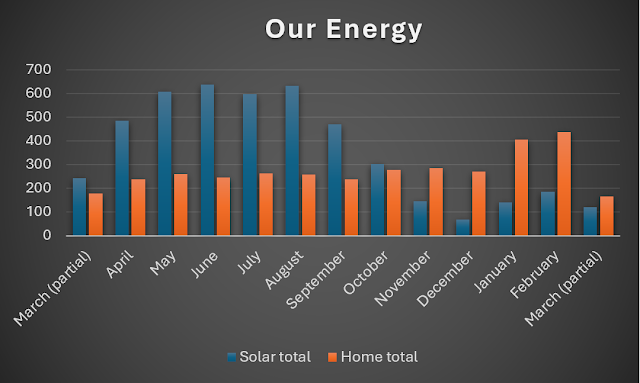
 We had out solar and battery system installed a year ago and so I thought I would share the stats! 


Yes, we generated 4.64 MWh and we used 3.2 MWh, meaning a surplus of 1.4MWh! 

We got a BEV recently, though, which will use up a lot of that difference in the future. But we have about 4k miles worth of spare capacity there. 

Here is the usage and generation broke down month-by-month. Big surpluses from April to September, March and October are break-even months, and November – February we are in deficit. 

Not too surprising given that we have an East-West roof rather than South-facing. 

We had some data connection issues in November and December so for those months the data might be a bit lower than it should have been, but not by a huge amount. 


Graph of solar generation and home electricity usage


What are the conclusions? 

I'd say "get as many solar panels on your East/South/West facing rooves as they can fit."

We need to switch over to renewable electric energy ASAP, and to "electrify everything" in order to "stop burning stuff." 

I kind of wish we could have crammed a few more panels on there, given that the panels themselves are pretty cheap and a lot of the cost is the electrical work. However, we had a budget at the time. 

Monday, 1 January 2024

Alabama introduces complicated hourly tax system

 I've been very intrigued by a newly introduced tax calculation in Alabama.  

A lot of the information I've found about it comes from law firms, who are no doubt explaining it in order to encourage businesses to hire them to make sure that they are compliant. 

How does it work? 

As well as any federal income taxes, Alabama charges income tax at 2% to 5% on a progressive basis. 

Don't rely on my simple explanation here as legal advice, but here goes!  

The new law proposes that workers who are performing more than their contracted hours, which in turn are over 40 hours, will not pay the Alabama income tax on that income. 

So the workers will only pay federal tax on their overtime work. 

They will still pay the Alabama tax on their standard hours, but not on their overtime.  

So their tax rate will still be 5% on some of their earnings (say if they work 39 hours), but then drop to 0% for earnings representing overtime hours.

So for someone who works 45 hours they would have 40 hours of earnings at the standard state-tax-rate and 5 hours of earnings that are state-tax-free.  

Benefits of the system 

The advantage of the system is that workers will face a lower marginal tax rate when offered overtime work than they would do normally. 

This can be achieved without lowering the standard rate of tax (5%) which would of course completely erode the tax revenues. 

I think from Alabama's perspective the aim is a form of tax competition - set up your business here and your workers will be more likely to accept overtime work. 

I expect there is also an expressive element as well - "hard workers shouldn't pay more tax as a result of their striving." 

But in economic terms, the aim as I've noted above could be framed more technically in terms of marginal tax rates. Progressive tax rates discourage high earnings, whether that comes from working more hours or from doing higher-paid work. 

Disadvantages of the system 

It might seem to be a lot of trouble to go through to provide a 5% reduction in marginal tax rates. If the system was applied on federal income tax it would of course be much more impactful, but Alabama can only change its own state tax rules, not those of the US government. 

There will be compliance issues in order to assure that the system is not being abused. Firms will have to do extra reporting, and be expected to apply the new tax rates to their workers (and not just claim and pocket the tax refund themselves). Hence why law firms are offering their assistance. 

Even though employers take on the administrative burden of income tax, the Alabama state tax administration will presumably have extra costs as well. The tax authorities are going to have check the claims by employers to make sure that they are not fraudulent.

The state needs to know a) How many hours workers are contracted to work and b) how many hours they have actually worked. If they have this information they could apply my hourly averaging system (see below).   

Another concern is that this might concentrate work into fewer hands - employers will hire fewer employees and work them longer hours. This seems a strange thing for a state to subsidise. Surely they would want to have more workers employed overall? Presumably the thought is that other firms will set up in Alabama and have their overworked Alabamans provide goods to other states. 

Why not go all the way? 

This Alabaman system is very interesting to me because it is trying in a very crude way to do the thing that my Hourly Averaging system is doing: to tax people who work more hours at a lower rate than those who work fewer hours. 

If the aim is to incentivise work then why not go all the way and impose an hourly average tax calculation? 

The Alabama system does not incentivise part-timers to increase their hours. Or incentivise the early-retired to return to work. 

My proposal is that everyone should have their lifetime income divided by their lifetime hour credits. These hour credits represent the number of hours the person has worked (or been excused from working if they suffer ill-health). This average is used to determine that person's lifetime tax rate, which is in turn used to work out their tax rate on their most recent portion of income. At each point the person will have paid the correct lifetime amount of tax and received the correct  

Such a calculation can be fully progressive - low earners who work long hours at a low wage will have a low tax rate (perhaps even negative with an hourly subsidy). High earners who work short hours  (say a part-time lawyer) would have a higher tax rate. 

Everyone has an incentive to work more, with one difference. 

I proposed a maximum number of hour credits, beyond which point people do not get any further reduction in their tax rate. This is an optional part of the system, but I proposed it for a few reasons:

  1. To avoid incentivising overwork 
  2. To reduce the potential for fraud
  3. To avoid incentivising the concentration of work within each enterprise. A long-hours option for some and few/no work options for others. 

The maximum hours proposal is not key to the system but I think it is a good idea. Alabama are sort of doing the opposite here - Alabama are only applying the hourly tax reduction ABOVE a high threshold. 

Will 2024 be the year Hourly Taxation starts to gain traction? 

I will be watching the Alabama system with interest! 

If a Conservative state can make hourly taxing work then I don't see why my progressive version cannot be seriously considered. 

The potential administrative issues are the big barrier to the implementation of my hourly tax proposal (along with ideological opposition from free marketeers and top-down-statist socialists, and concern about international tax competition).  

Will 2024 will be the year in which hourly taxation finally gets taken seriously? I certainly hope so!